
Big data and cell phone apps, submitting paperwork, mandatory tests before entering the city…and, good old masks. A brisk walk through how China does it day-to-day.
HI Parents! We are looking forward to starting our new semester on Monday! Here are some things to prepare:
Before noon on Sunday, February 28th please send us your child’s green code and a screenshot of the 14 day travel history for all people that live with your child.
This was part of the bilingual note I received in my older daughter’s kindergarten WeChat group, which has all her teachers and all parents. The group is the de facto channel for all things related to her class and updated regularly with information and requests.
Usually, any announcement mentioned in the note is followed by numerous responses from all the supportive moms.
“Thank you, can’t wait!” is one example.
I scroll through a few and have some questions. I want to know how to send my itinerary.
Another of the teachers shares this mini-app in the group for me to reference.
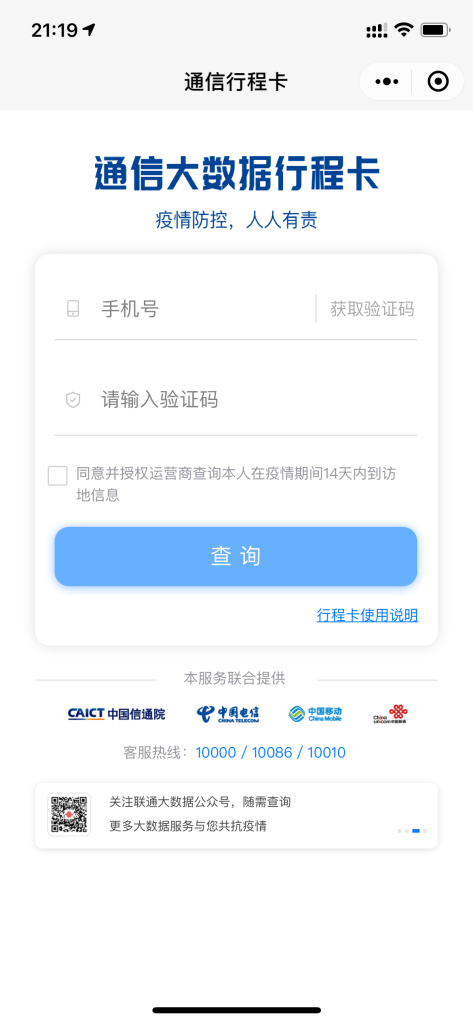
I scan it, add to my WeChat account “mini-apps” to make it conveniently accessible any time. To use it, I simply enter my cell phone number and get an output telling where I’ve been for the last 14 days. Such as below.

Safely Shanghai.
I also want to find out what the rule is for leaving Shanghai going forward and returning. I have a potential client meeting next week in Beijing and if me leaving means the kids staying home for two weeks upon my return, I think I will politely bow out of the face-to-face, though I relish the opportunity for a day trip.
(Side note: the kids are just wrapping up five weeks at home for the winter holiday, so I am in no way looking to put that return at risk.)
The teachers need to clarify it for themselves because the rules keep changing based on risk factors. The conclusion is, if going to medium to high risk areas, it will require 2 COVID tests and self-isolation for 14 days, negative results paperwork submission and the green code (see below). For low risk areas, it will require filling out a special spread sheet (including daily temperature check, detailed itinerary etc) to be provided to the school and provision of the same green code.
And, just to be clear. I’m not complaining about my kid’s kindergarten. Their kindergarten is nothing short of awesome. I highlight this as an illustration for how COVID containment occurs in a day to day situation for those of us in China.
Here’s another example.
Since I may be in Beijing next week, it comes to mind that I may need a COVID test to enter the city. It’s a bit strict there and they are hosting the annual “two sessions” Party congress in March. That usually requires a bit of a step up in security.
After checking, sure enough. I need to take a COVID test and show proof that I don’t have it prior to boarding any plane or train. But, I don’t need it when returning to Shanghai.

The last example of how this plays out is in shopping malls. Unfortunately, we go to shopping malls all the time. Living in the heart of China’s cosmopolitan city makes it a bit unavoidable, particularly on rainy days like today.
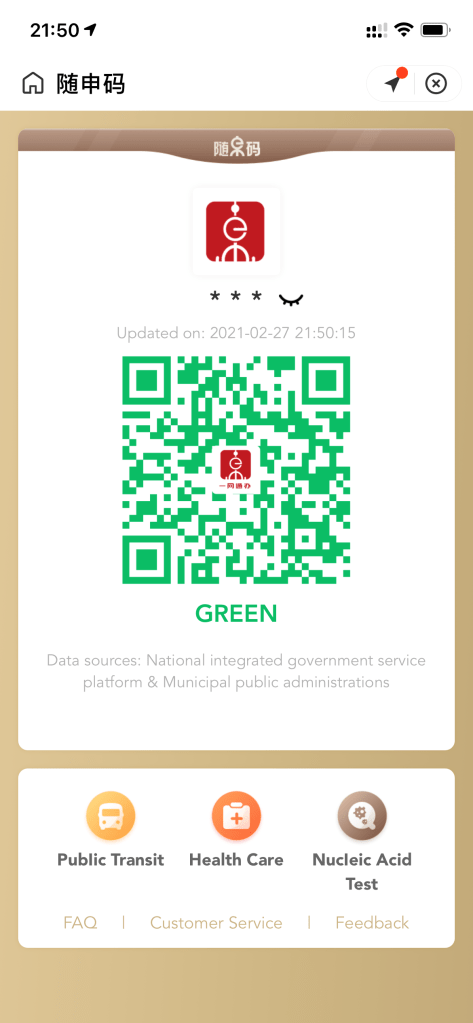
“Show me your health code,” the door guard standing next to the tall temperature tripod gravely mutters to one person after another. And, like clockwork, one after another pull out their phone, swish the fingers a few times and turn their phone around to prove their health by showing their screen. Here’s what they show, one after another. Green for healthy.
But, when we finish, that’s not the end of it with me. “Put on your mask.”
“Put on my mask? There’s like no cases in Shanghai,” I honestly retort.
“Put on your mask.”
Mask goes on. And, I go in to survey fragrance, the latest Tesla models and get groceries with my daughter in tow.
Hence, the nature of what is needed to be done to contain COVID in China – be it a test, a submission of paperwork, or real-time personal data points populating a screen – are very much contingent on where one is going, what group one is a part of, and where one is at any point of time.
In the corporate world, I would give – what I thought at the time – a cool name to a client plan that would change according to actual needs like this.
“This is flexible within a framework.”
Sounds credible. Has a nice ring to it. And, I know I didn’t make it up.
I think this would fall within that category. And, it seems to work.
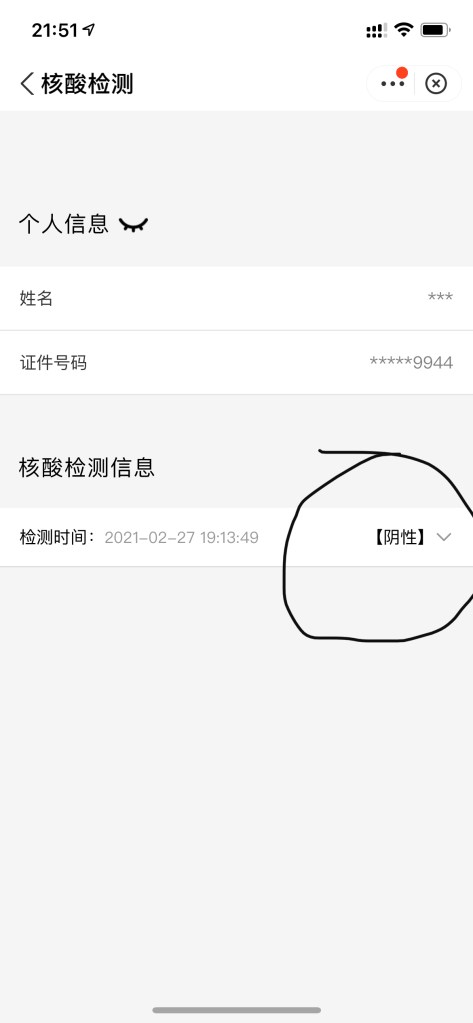
And, before I end this brisk story, let me share something that I found very interesting. I am not able to pick up the paper test results from my nucleic acid COVID test until tomorrow at the hospital, and they can’t email me until Monday. But, I noticed just now when looking at my “green health code” above that there is an option at the lower right I never noticed. Note the icon. I wonder if my data is linked. I click it open, which shows there was a lab test done at 7:13pm under my name today, which was about 8 hours after I took the swab. Meaning, it’s probably the results. And, bingo. My test results are negative, as circled below. I use an app to find my results faster than the official hospital channel. And, this is all within the Alipay app, owned by Alibaba.
And, that, my friends is part of why I love living in China. I am always pleasantly surprised my consumer-centric innovation!
What can other markets learn from this?
What I didn’t explore here is that generally everyone is fine with this approach. People want to be safe, and as long as they feel they are being taken care of, they are fine following the rules, submitting information and just getting on with it.


