Growing up, I remember Cadbury cream eggs at Easter. I used to love those things. A hollow shell of chocolate with a creamy yellow and white nougat center oozing all over my hands. Some kids may remember Paas fuzzy rabbits or jelly beans. Those are good too. I also relished the vinegar-smelling liquid we’d dip our boiled eggs into with a special tool to change their shells to a light tint of blue, yellow or green. Once dry, mom would hide these around the house and have us hunt for them the next day.
Those were great traditions. But, the only tradition that stuck with me my whole life across the world and over the decades was celebrating the resurrection of Jesus Christ. Easter is a day of celebration, joy and new life. It’s a day to be happy and a day filled with hope. While the church we regularly attend was planning on a nice Easter lunch today, we’ve moved to an online format for over a month now due to Covid restrictions across the city.
Throughout my life, this is one of the strangest Easters I’ve celebrated, no question.
Covid Testing Bright and Early
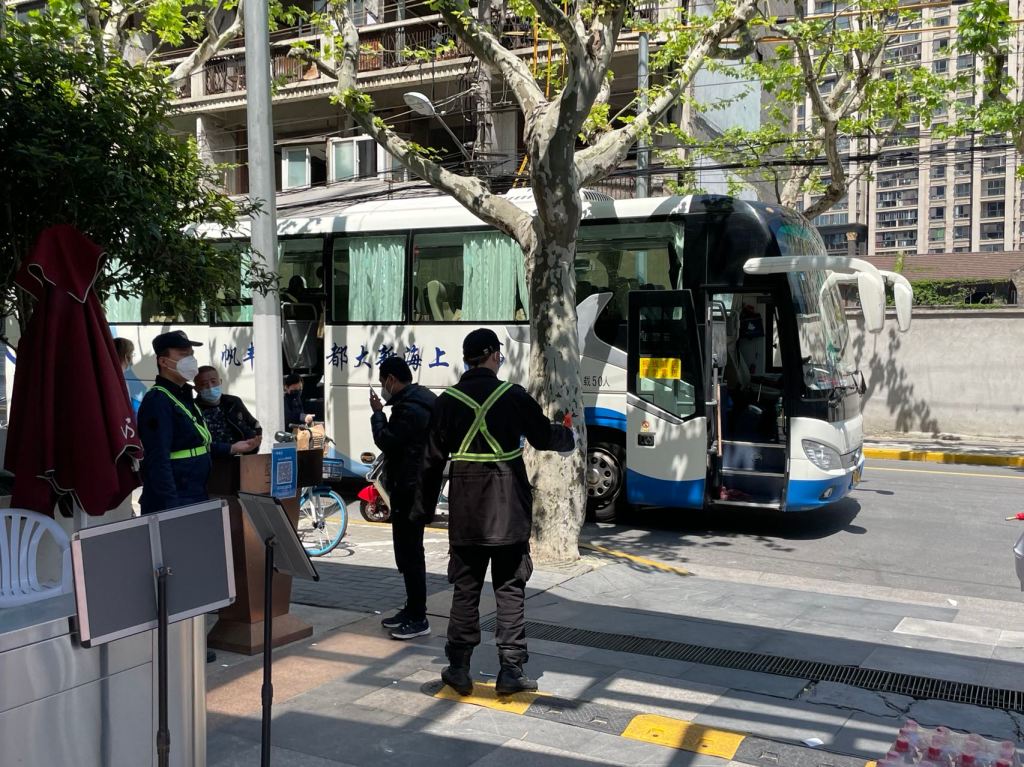
I received a notice in WeChat from our building management at 7:52 this morning informing that a round of Covid tests would be performed starting at 8am this morning, and we’d be notified by a knock on the door as to when that would begin. This was accompanied by a detailed description of exactly how this would play out and the related rules. This knock came around 10am I think it was. Down we go, waiting in single file along with the other people who live in our building.
Testing notice from housing management this morning on WeChat
Last night, the group WeChat from our building sent a note with this update just prior to midnight. I immediately asked my wife not to set her alarm. Often these planned tests are delayed – and in one case was even cancelled as night fell.
Easter Morning Testing
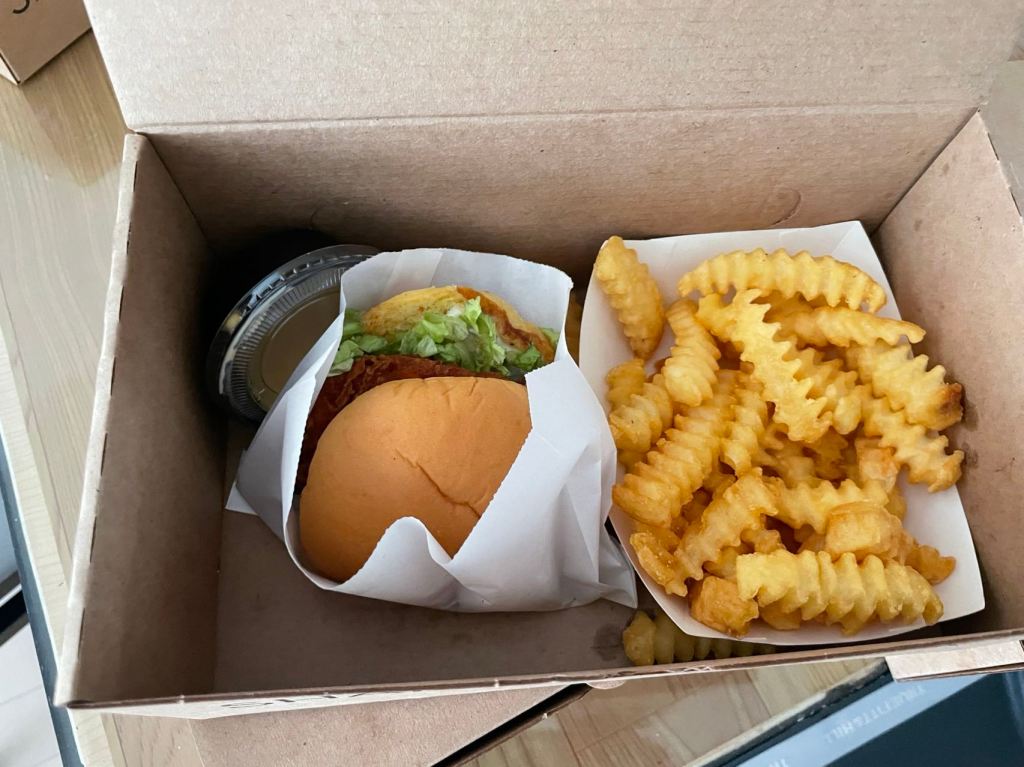
Indeed, we were glad to not need waking too early on a Sunday. The highlight of the day though was the arrival of Shake Shack just before lunch time.
Placing Orders as a Big Group
We’ve been under strict lockdown for about three weeks, defined as staying inside our apartment unless going downstairs for Covid tests. Since this has been the norm for the entire city, logistics have shut down. An urban culture that is used to same-or-next-day delivery and fresh groceries and food stuffs delivered within 30 minutes of placing an order by smart phone app, the current lockdown has been ground-shaking to say the least. The mostly young men who deliver food and other supplies are also on lockdown. This has led to massive issues getting last-mile delivery.
An urgent response to this logistics nightmare has been group buying on a massive scale, where some stores keep themselves open and deliver large batches themselves to housing compounds. These stores will create a QR code with a set menu of items which one can scan and a brand promise of delivery to a compound meeting a certain minimum threshold. This leads to social media sharing on a grand scale as residents demand being a part of an individual order for everything from yogurt to hot pot.
To reach the minimum amount, an organizer in our residential compound issues the menu and a call to action, and a commitment to making the order, generating a list that is shared in the group. Interested parties join the list and pay the organizer. When the order arrives, it gets distributed building by building downstairs and tenants can go and get it. Up until the past couple days, packages were delivered by security personnel in hazmat suits.
Back to Shake Shack.
Someone in building six adjacent to us issued a big group buying order call to action for the compound yesterday, and my wife – nimble as usual – jumped on the chance to get us hamburgers delivered just in time for Easter lunch.
My wife is on top of all the group buying. She’s constantly checking a variety of chat groups and placing orders…all day long. I also notice much of what’s going on and make recommendations but it’s hard to stay so engaged. It’s absolutely exhausting to have this as a lifestyle and a cause of much anxiety to need to constantly look at the phone to make sure there’s an adequate variety of food in the fridge.
Once this stuff is behind us, it will be time to put the phone down and try to take a few deep breaths.
For now, we are grateful this year at Easter that after three weeks we could finally come downstairs in the compound, breathe the fresh air, feel the gentle spring breeze and run alongside the kids while they ride their bikes. While we have no visibility on when we can venture outside the compound, coming outside is still something to be grateful for.
And, we are grateful for hamburgers and fries. May you too experience the joy of Resurrection Sunday. A day of new life and new hope.
It’s easy to complain, but it’s more meaningful and motivating to find something to be grateful for today.
It’s a topic I’ve been extremely interested in for a very long time, and I know it is highly relevant for many of us around the world, in particular for those who have chosen to emigrate to a new land for many years. We immigrants (I suppose I am one, in a sense, having spent nearly half my life away from my native country) struggle with identity. We want to be accepted in the new place where we live. We miss home, but don’t really feel like we belong there either.
For example, from the outside, the United States has acquired a new set of cultural norms. I have to admit there’s many cultural dynamics that don’t make a whole lot of sense to me right now. I love going home to spend time with family, and there is nothing like spending a day at Lake Michigan, the sea-sized freshwater lake that my home area shares with Chicago and Milwaukee.
Lazy summer days in Michigan 密歇根州的慵懒夏日Dune grass on Lake Michigan in November 11月密歇根湖上的沙丘草
There is a life-long internal dissension with wanting to return to the place of my youth when times were simpler and there was far less construction and white noise.
我想回到我年轻时的地方,这是一场终生的内部纠纷,当时的时代比较简单,建筑和白噪音要少得多。
Sidebar: right outside our apartment, there is a construction site that has been building asubway exit and mixed use shopping complex and office building since the outbreak of Covid. The site was largely open for a few years, and starting about six months ago the site secured an all night 24/7 construction permit. Over the past twenty years, I’ve needed to develop greater resilience and toughness toward noise. City life is loud anywhere. But, there is nothing like 24/7 construction to change the game.
When the jackhammer roars at midnight, I hunger for the tranquility of small-town life in Michigan. A tranquility that seems intangible and of greater value than gold – or, maybe…Bitcoin?
So, I’ve been developing a ‘retirement strategy’ for the past few years targeting a return to the US in later years. Yet, I’m nearly certain that the strategy will fail. Or, rather, that this tranquility which is intangible is truly no where to be found.
I was thinking about this issue this morning, given the New Year. There’s a reason I left my home town, after all. I was a young man, seeking escape and adventure. The very tranquility that calls me today pushed me out yesterday.
There is such a vibrancy in Shanghai and an overall newness as the most cosmopolitan city in the fastest changing society in the world. In many respects, it really is the place to be.
While I never set out to be an immigrant here, I greatly enjoy being a part of society. In my more reflective moments, I feel like ‘I’ve made it’. And, there are so many people I’ve been able to teach and mentor over the years – those who want to understand China more and vice versa.
It may be this sense of accomplishment that keeps me going. I remember when I just arrived here. I had no money, no job and was saddled with college debt. Those circumstances may have led to become more enterprising and hard-working than had I stayed home. Indeed, aren’t immigrants reputed to be hard-working people able to bear grunt work day in and day out until they ‘make it’ and earn their spurs, so to speak?
I struggle today with a different issue: is this it?
今天,我为一个不同的问题而挣扎:生活没有更大的目的吗?
This is a question that probably haunts most people my age. Once accomplishing what you set out to do, it’s easy to fall into a sense of dissatisfaction. I’ve undertaken the adventure of a lifetime, and I’m glad it’s worked out well. And, I’m worried about setting myself up for retirement so I can step out of the rat race and enjoy a life of tranquillity?
I think what I need is a new adventure. If that means moving back to the US and having massive reverse culture shock, so be it. But, maybe it’s something else. Maybe it’s going deeper into China. I’ve put nearly half my life into China and it makes no sense to pull out now.
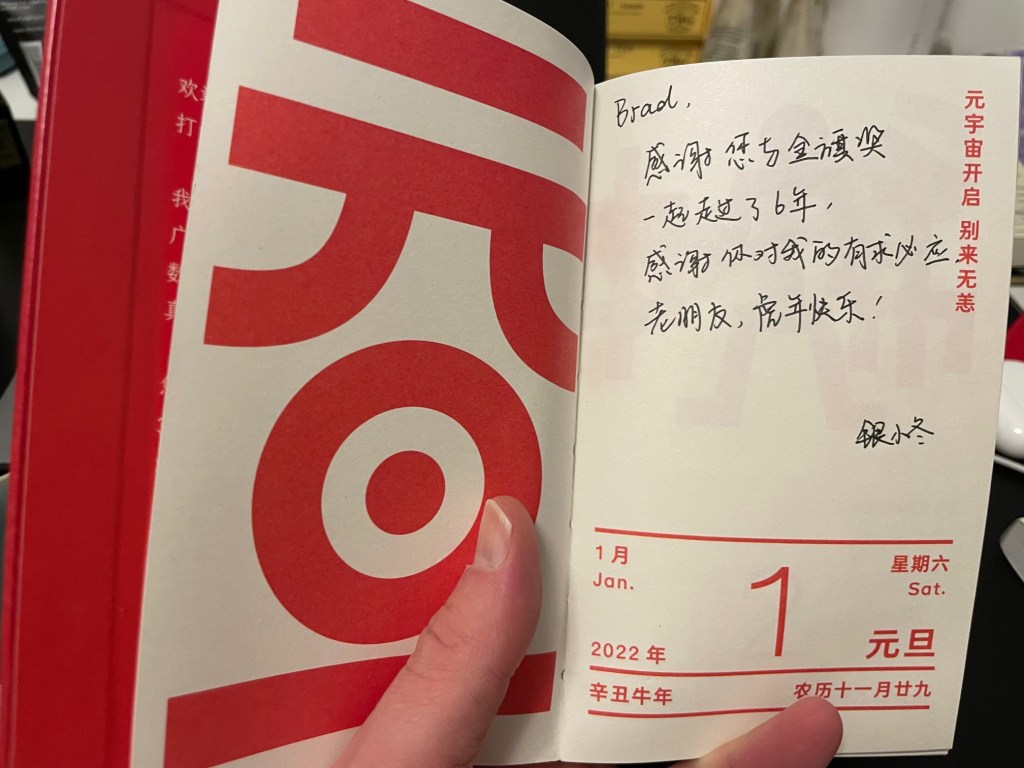
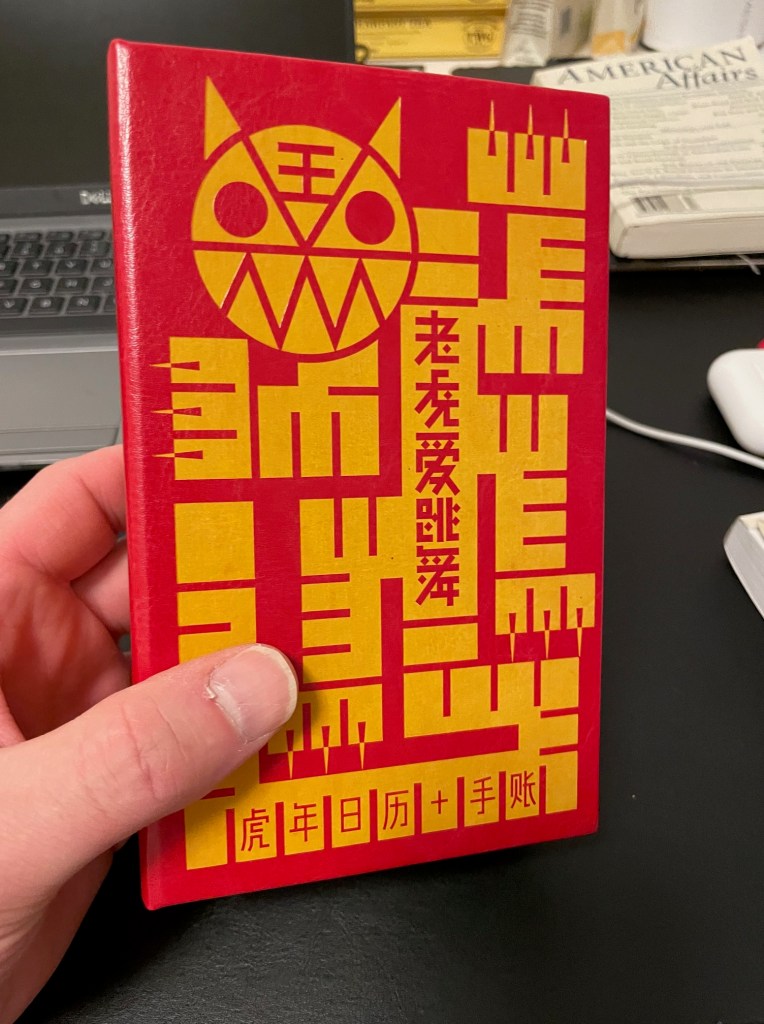
A New Year’s gift from an old friend. A wonderfully rare hand-written note of gratitude in Chinese. 老朋友送的新年礼物。一张罕见的中文手写感谢信很有意义。
2022 may be the year for new goals. The last time I recall having written goals was 2012, and we’ve reached many of them. One of my life goals that I established in 2012 that I have not reached and – indeed – wrote off complete is….drum roll…
That’s right. The most embarrassing and meaningless goal I’ve ever written in my entire life. Glad that one is behind me. I’m not even a fan of the brand any more. But, I think it’s time to dream big again. I think going forward, it’s about significance.
How many of us have given up on our dreams this past year? We’re likely sick of the headlines, Covid-concerns and geopolitics. While I don’t believe in fooling ourselves with false positivity, maybe this coming year presents a new opportunity to see things differently.
Maybe we need to see things with new eyes. My eyes were opened yesterday when I was speaking alone with my daughter and talking about my childhood experience in the United States and my concerns about the US. I shared that the American culture has turned away from following God’s principles. And, she asked what it was like in China. I said, better and better. And, there’s a lot of people who believe in God here. She began to say reference “our country” in her sentences and it suddenly struck me that she was referring to China.
Having been born and raised in China and spending all of that time with me, naturally “our country” and shared experience is China. It does sadden me that nearly all people here call her a “foreigner” when they see her though. She hasn’t realized it yet. But, wouldn’t it be wonderful if we didn’t emphasize blood and origin so much with each other? I am concerned that she won’t be fully accepted in her own place of origin when she gets older. Although her first language is Chinese and she’s just as Chinese as anyone else here, she has curly auburn hair which – though beautiful – makes her very different along with her other distinct features which I’ve passed along. My experience in this has been very frustrating (refer to the link at the top of this story for my other article on identity).
I’ve never heard such a strong statement of verbal acceptance of my desired identity in China – and, it came from my daughter, who shares my experience in many ways. Yet, when I shared how I felt about this issue with my Chinese friends, I got a mostly confused response. They don’t share the experience and they don’t understand it for the most part, but they try to empathize. Diversity and Inclusion is a hot topic in the United States. But, it’s a global issue. It’s just that people make such a big deal about it in the US.
If only we all saw the world the way a child does. If we could unconditionually accept people the way they do, there would be much more harmony in the world.
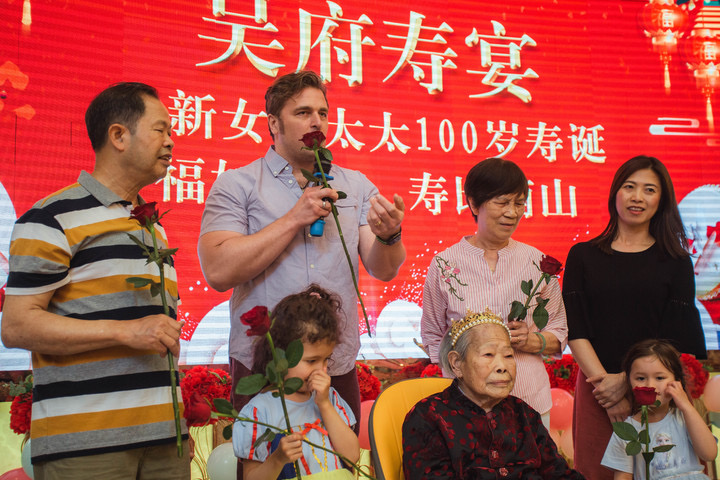
Very few of us live to be 100 years old. Something like 2% of us perhaps will make it. So, it was rare to celebrate my Chinese grandmother’s centenary this past month. The actual date of her birthday, according to my cousin, is 农历四月初六。This is the fourth day of April in the lunar calendar, or May 17th in the Gregorian calendar. Since the specific dates of the lunar calendar change annually, her birthday is marked by the annual week-long Chinese Labor Day holiday, which begins on May 1st. Not only is this easier to remember, but it’s much easier getting the relatives together.
It’s also a bit confusing with my in-laws. We never know when their birthdays are because when they were born, time was marked by the lunar calendar. So, we celebrate my father-in-law’s birthday around the same time as my wife’s (whose birthday was marked by the Gregorian). It simplifies things, but I’ve always thought it would be cool to know the actual date so we could create a surprise of some kind.
Going Deeper into China – to the City of Grace and Peace
Grandma’s birthday was “19 tables” in size. The scale of Chinese celebrations is determined by the number of round tables that hold ten guests. Originally, there were to be 21 tables. Two tables couldn’t make it. We had the honor of sitting near the front. My father-in-law is the eldest child, and my wife is the eldest grandchild, so it’s a special honor.
The party was held where grandma and the close family live, in the city of Enping (恩平).
“Enping is a tier 16 city,” my cousin says in a matter-of-fact voice as he glances through the rear-view mirror. He’s spent his whole life here and done well for himself. He is married with a daughter, works in an energy company, has his own car and his own home which is a comfortable 20 minutes away. He’s always there ready to grab my suitcase at the train station when we visit.
Fresh Mountain Air
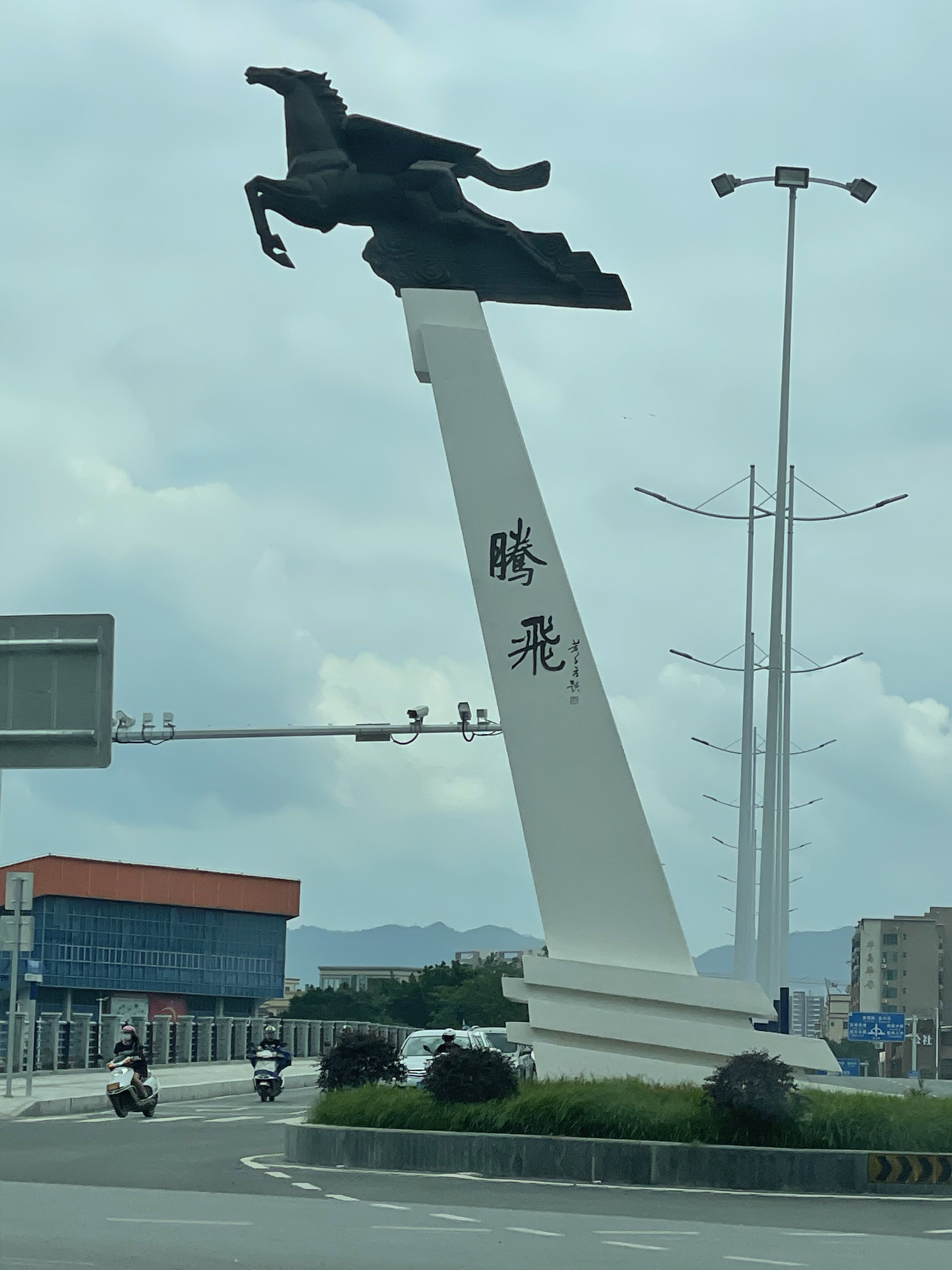
As long as I’ve been aware, cities in China have been organized by tiers. Tier one cities are the ones everyone outside China is familiar with: Beijing, Shanghai and Guangzhou (and, many are unfamiliar with Guangzhou (or, Canton, where ‘Cantonese’ comes from)). And, they go down from there. So, when my cousin said Enping – which literally means ‘grace and peace’ – ranks so low, I didn’t believe it. Granted, there is no airport. This has always struck me oddly since Enping is the home of ‘China’s Aviation Pioneer’, Feng Ru.
China’s Aviation Pioneer – Unknown in America
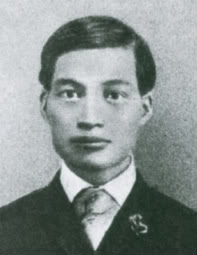
Though I never heard of Feng Ru (冯如)until my Chinese cousins led me up a hill once years ago to look at his memorial statue and tell me the story, his story can be found with a simple web search. Indeed, he was one of the great pioneers of the early twentieth century.
Feng Ru (Source: Baidu Wiki)
According to an entry worldatlas.com published in 2018, China has over a 100 cities with a population over 1 million. This is over twice that of India, the runner-up and over 10 times that of the United States.
Living in the center of the largest city in China (population of Shanghai must be nearly 30 million), it’s easy to scoff at cities that rank in the millions as “small towns”. According to a search on Baidu, Enping has a population of around 500,000 and is indeed a small city by Chinese standards. But, it’s still pretty big. Also on Baidu, Enping is a tier five or six city – certainly not a tier 16 city, as my cousin humbly claims!
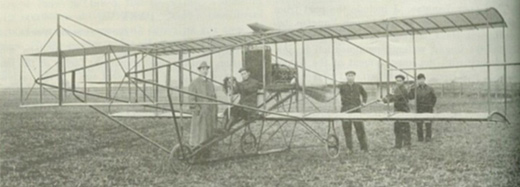
Back to Feng Ru. I was amazed after doing some basic desk top research to learn that he was one of the world’s first pilots and airplane manufacturers. He built planes in Oakland, California, just a couple years after the Wright brothers took their historic flight. He was the first to fly over that part of the world.
Yet, who’s heard of him? I met with a friend the other day from Oakland who comes from a Chinese heritage himself. He hadn’t heard of Feng Ru either. I find that somewhat sad. China’s Aviation Pioneer soon thereafter returned home to manufacture planes for his country. He died flying over my wife’s hometown in 1912, the city of Guangzhou.
There’s been a recent surge of interest in the United States by Asian Americans – and, more broadly – in stories of people of Asian heritage who have made an impact on the local culture. Feng Ru would be someone worth celebrating, a man who is a pioneer in his own right but nearly completely overlooked.
Traveling nowadays from Guangzhou to Enping is always entertaining. There is a high-speed train that takes only an hour and twenty minutes or so, but during the holidays it’s mostly standing tickets only. So, my father-in-law purchased mini stools for us all to sit on near the doors to make the trip as comfortable as possible. He’s got a stack of a dozen or more of these stools at home accumulated for just such a purpose.
There is a noticeable change in the air when arriving at Enping. The city is tropical-hot, and considered part of a rain belt, getting ample rain throughout the year. But, there is a freshness in the air that invigorates. It’s the freshness I often experience when outside a megacity, being surrounded by mountains and lush vegetation.
Breaking out of my Shell
As we arrive at the venue, I learn that I am to give a brief speech on stage as part of a blessing to grandma. “You are the only foreigner in our family, and have quite a unique point of view,” I am told by my other cousin who is the primary organizer.
I used to be an introvert but living in China has helped me break out of my shell. The first couple years were painful, sitting at the customary round tables surrounded by people always asking me a variety of questions in well-meaning fashion. Answering with broken Chinese and half sentences for a couple years, it’s amazing people had patience. It may also be part of why I would often drink too much on such occasions, easing social anxiety.
To be fair, learning a foreign language requires the willingness to look and sound ridiculous, often. One needs to develop thick skin, which is really a valuable asset over time. So, when I learned that I’d be giving a blessing soon on stage, I wasn’t that surprised. But, I was concerned about saying the right thing. I wanted to make a positive impact and say something meaningful. I also assumed this would come at a later stage in the gala dinner. Yet, again, I was completely surprised. My father-in-law was saying something in Cantonese and then smiled and passed me the mic.
I said something silly like saying my name and how long I’ve been married to her oldest grandchild. And, happily married! (Why did I just say that?!) I then recounted the first time I met grandma and how she welcomed me into the family. She was waiting outside her home for us and led me inside by hand. Though she couldn’t speak Mandarin and certainly would never guess her oldest grandchild would marry an American, her simple gesture was a huge statement of immediate acceptance.
Family Celebration
And, that’s from the heart. It may have sounded silly on stage. I don’t know. I wasn’t ready to give my brief speech yet. But, I’ve often found that when you speak from the heart, people listen and appreciate it either way.
The Power of Positivity?
The next day, we were relaxing at grandma’s house. I wanted to hear some insights about her life, so I asked some questions through my father-in-law (I’ll learn Cantonese next, I keep telling myself). What did she think about the party last night?
“Expensive! I just looked at all that food and drink, and I cannot imagine what that must have cost!”
It doesn’t matter whether it’s China, the United States, or anywhere else. I trust that grandmas are the same around the world. My own grandmother just turned 93 and she is the absolute picture of energy. Her mind and memory are extremely sharp.
My wife said something that made me think: “I’ve never heard my grandmother complain. She’s had a hard life, but she’s never complained.”
Come to think of it, my American grandmother is renowned for laughing and jokes herself. The late Norman Vincent Peale popularized the power of positive thinking in the American mind. Yet, there is something to it.
If we complain less about people and our circumstances, will we too live to be one hundred? It’s worth thinking about.
My sister still laughs when this memory comes up. I was back home visiting my mom at her lake house in Michigan years ago. With floor to ceiling windows facing the small and peaceful lake, I couldn’t think of a better place of respite from bustling Beijing. Newspaper in hand, yanking back the lever of the plush La-Z-Boy hard, I was thinking: “finally”.
My sister, Amy, came over with my young nephew, Vaughan, whom I’ve only seen a handful of times. “Uncle Brad, can you play with me?”
“I’m reading my newspaper,” I respond curtly without looking up. Amy laughs.
Peaceful respite at the lake house
She still laughs today because I’ve changed from being a stuffy older-than-my-age stiff to a jolly young daddy, and the transition is massive. I never liked hanging around kids before I had my own. When people coo’d at cute little babies, I would try to find the furthest corner or exit. ‘Yeah, they’re cute. Great.”
So, imagine my surprise to experience just how much Chinese love kids. We’ve all been taught about cultural differences, and probably if most of us are honest, we tend to prefer our own culture over any other. I like the way Americans interact. I like the way we work at the office, and I love the boundaries we place on work and family time.
But, I have to admit. There are some cultural differences that may be superior to my own. There is one cultural asset that Chinese do better than anyone else I’ve seen.
They absolutely love kids. Now, I know this is a generality and there are certainly exceptions. But, I’ve never seen people be more patient, more understanding, more appreciative of children than the Chinese people. They are wonderful with kids.
Just to provide an example, my kids love taking the subway lately. It’s fresh and exciting. So, we take it when we can. And, when I step onto a crowded subway, immediately to my right and left, someone will stand up. Once catching eye contact, they smile and wave a hand over to the seat. My kids love standing on the subway, seizing the handles with their little hands in a small act of agency over the momentum until we get off. So, it takes me a bit of time to refuse a seat for myself or the kids. This act of kindness is so glaring because the subway can be one of the coldest places in public. People don’t talk. We look at our phones and shrug past one another without the slightest recognition. But, when a vulnerable child shows up, a light of warmth immediately lights up from one random stranger to another.
Going back to the Good ‘Ole Days
China’s a busy place still under radical transformation. It’s impossible to describe just how things are here to the uninitiated. One topic that continues to come up with Chinese I speak with is how much they miss the good ‘ole days. They miss the simpler days when they were younger and everyone knew each other in their housing compound, when people asked about each other and looked after each other.
Indeed, before having kids I felt much lonelier. It’s hard to know neighbors. People don’t naturally greet each other in the elevators. I’m from the Midwest of the United States, a place famous for friendliness. People wave at strangers when passing on the sidewalk. Granted, the Midwest has received some attention for inauthentic friendliness (see “Midwest Nice”) but overall people in my hometown area are friendly and it feels nice. When growing up, I somehow learned that New Yorkers were cold and rude without having much exposure to them. I’ve had the pleasure since of having had two former bosses from New York City, both who were as direct as it gets – and, as generous as it gets. I’ve also been in a company famous for its collegial Midwest friendly culture that paid me far too low. So, it’s important to question assumptions as we go through life and acquire real experience.
Be with them whether it’s yawning…
…or getting a pick me up.
So, when Chinese tell me they miss the good ‘ole days, I naturally think about sincere midwestern friendliness. And, I’m not too far off the mark. They miss when no one had a lot of money and when the times were simpler.
Having a child in China gives you access to the good ‘ole days, both the Chinese version and the Midwest American version.
Losing Identity, or Acquiring a New Name
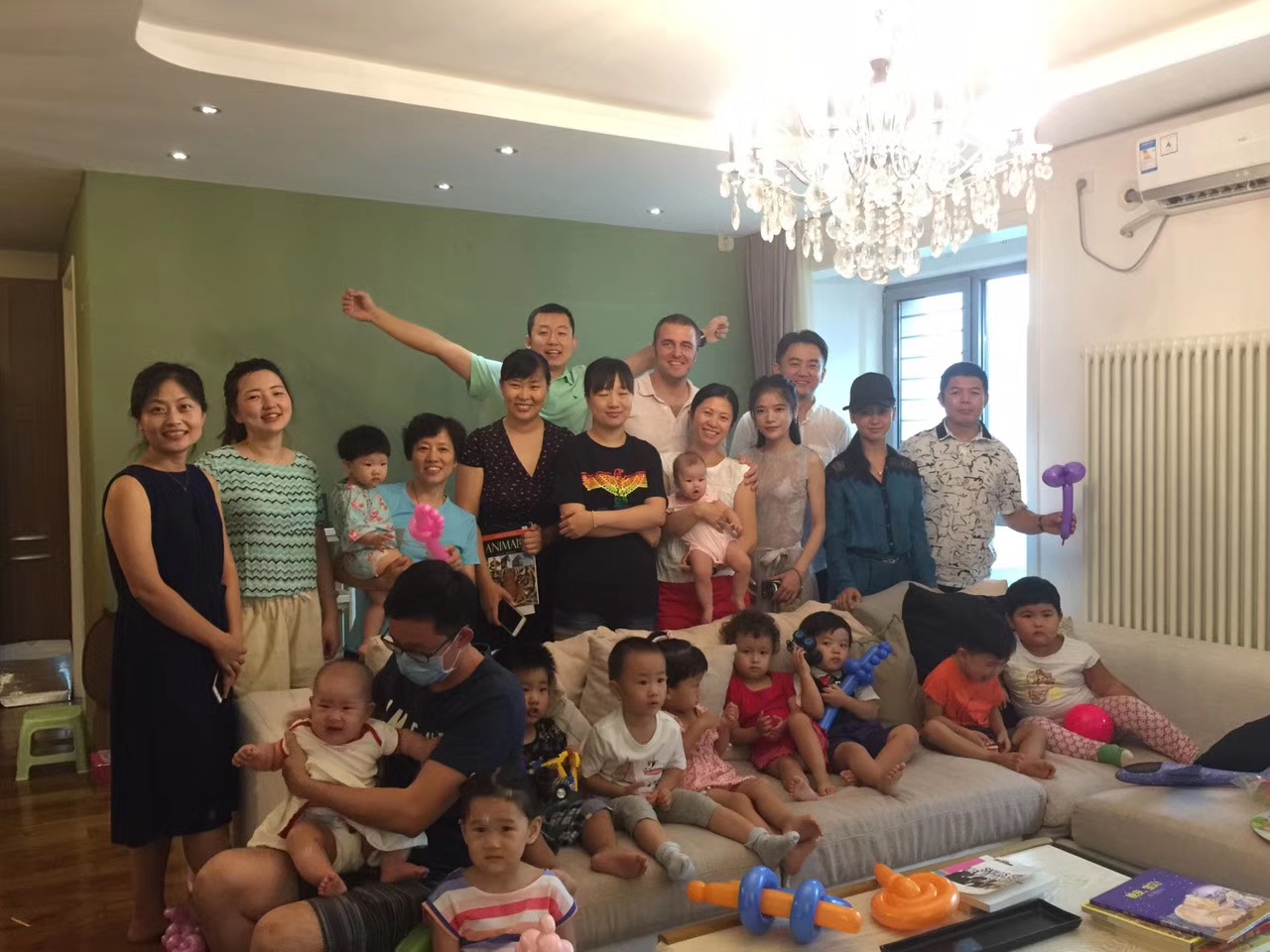
It is nearly impossible to not make friends with the neighbors once you have kids. This started the moment our first daughter, Vera, was born. We moved into a quiet compound just prior to my wife getting pregnant. There were several parents like us, who had babies the same year we did. They too were working professionals.
Some people make friends over cigarettes. Others over drinks. For us, children were the ultimate conversation starter. Whereas we once all needed to think about a shared topic before approaching a stranger, now there was an immediate connection.
“Look, it’s a little sister. Say hi to the little sister.” Chinese use terms that draw people closer. They would see my younger daughter as the little sister of their own somewhat older child. Immediate connection. Once you’re a sister, you’re no longer a stranger. And, so a conversation starts. And, the conversation turns into a regular parent acquaintance. And, the acquaintance turns into a genuine and quality friendship.
I lived in Beijing for 15 years. Over this time, I’ve had many acquaintances and friends. But, nothing compared to the deluge of friendships that opened up through my children. Parenting is such a life-changing experience, and it’s a community experience. Parents share insight about what they’ve learned, where to go for the best childcare products, what kind of restaurants cater the best, etc. the topics are endless.
And, in China there are the grandparents who often help with the childcare during the day while mom and dad work. They all get to know each other for an added layer of friendship. Then, there’s the Ayi’s who take care of the kids when the parents or grandparents don’t, for the third layer.
The end result of this is an entirely new life dynamic of community where everyone gets to know each other, helps each other and is friendly for each other. And, it crosses socio-economic and cultural barriers. We had friends who were wealthy and friends who were not. Young children are the great equalizer in China. It really is a small taste of heaven.
Our Beijing neighbors getting up early to see us off to Shanghai
One of the biggest adjustments I’ve had to make is losing my name and acquiring a new one. To this day, no one in our housing compounds know my name. This is true for Shanghai today as it was in Beijing in the past. I’m ‘Vera’s dad’ or ‘Nini’s dad’ depending upon the daughter being referenced. I had a hard time getting used to this, always believing parents should maintain their identity and welcome children into the family rather than making everything about the child.
Then, I just got used to it. “Vera’s dad, do you want to get coffee next week?” one of my friends asked recently. He’s a cool guy, a partner in a law firm whose wife is a screenwriter, a very interesting couple we often meet as a family. I smiled when I heard him say it.
So, rather than feeling like I need to maintain my own identity, I’ve become comfortable acquiring a new name and getting on with it.
Some tips for enjoying the good ‘ole days in China:
Have children and get ready. Of course, no one should have kids for any other purpose than wanting to have them. But, get ready to access new relationships and a whole new enjoyment of living in China once having them. This may be hard for people who are more introverted. But, if you can befriend at least a couple other parents nearby, the content of your conversations which will lead to authentic friendships can go quite deep.
Be ok with losing your identity. Take on the new identity and the name that comes with it. No one will remember your name anymore but that’s fine. You won’t remember anyone else’s name either! It simplifies the communication anyway and it makes it kind of fun. Of course, people at work will call you by your name. But, outside work no one remembers it. Even your own family members will do this. For example, my mother-in-law calls my father-in-law ‘grandpa’ and vice versa. My wife and I still call each other by our own names, but that’s about it.
Celebrate the culture with open eyes. It’s easy to be culture-critical. It’s more challenging – and, more meaningful – to keep your eyes open for cultural strength. One cultural attribute in China worth celebrating is how much Chinese value children and the benefits that come with parenting here. And, there are many, especially in the early years. I’m convinced that having children here for the first few years of life is one of the best in the world. It kind of makes me want to have more!
I’ve said it once and I’ll say it again. Having children is probably the only dynamic in life that is absolutely exhausting yet supremely joyful, a uniquely symbiotic paradigm. I know of nothing else like this. Work can be exhausting, but it doesn’t deliver the joy. Companies try to talk up their family culture but it’s not the same, and it’s often completely inauthentic. Work can be satisfying, but there’s no joyful reward when exhausting yourself that deeply satisfies the spirit like having children does.
I had lunch recently with a couple friends that illustrates this. One of them has two young children, like I do. The other doesn’t yet have children. As we waited for our food, I pulled out two new boxes of painkillers and began reading the description of one of them I had never tried before. I’ve had poor sleep for probably a week or so now, and after about a week it accumulates to a dull migraine-like headache that can only be temporarily soothed by a painkiller and then a very painful half hour traditional Chinese shoulder and head massage.
You Do What You Have to Do
“Man, that stuff scares me,” said my friend who is yet to become a parent. He is so good with kids it amazes me. He’s great with my kids, one of the best I’ve seen. I certainly wasn’t as good with kids as he seems to be.
Me and the other friend look at each other and laugh. “No way. It’s great. We wouldn’t go back to the time before kids,” we agree.
Hangovers without Booze
I quit drinking over seven years ago. I used to drink too much and get terrible hangovers. I’m so glad that life is behind me, especially before my first daughter was born. So, I know what it’s like to fully function with a headache all day long. The difference is, instead of getting through those days with regret, I get through them today with a smile – often with laughs.
So, I swallow the painkillers. I get the painful head massage. And, my wife and I consistently tweak how we take care of the kids so that they sleep longer and won’t awaken at night. Last night, we finally both slept well again.
“I didn’t give her milk at dinner, and gave her less water after the bath,” my wife said. Smart woman. Milk takes a longer time to get through the system. Less milk at dinner time. Common sense is often trumped by the anxiety of hoping your child will grow faster and needs milk at dinner to accomplish that goal. Parenting is a process of dealing with your own fears and concerns and tweaking the program as you go. In this case, our personal need for quality and uninterrupted sleep is (temporarily) superseding the concern about providing adequate dairy. We can simply give more earlier in the day and through other means, like cheese.
To be fair to my kids, it isn’t just the poor sleep that causes the headaches. It’s probably also related to lugging a heavy backpack around the city and slouching over a computer. It’s a heady cocktail ending in pain.
So, what does all this banter about hangovers without booze have to do with having kids in China?
Having kids is all about learning as you go. My wife and I did everything we could to prepare for parenting. We read books, talked with friends and parents, and even took a course on pregnancy and birth together. Admittedly, the course was cool. I learned a lot about the phenomenal human body and how we are innately equipped to care for children.
So, we felt fairly prepared. Everything was in place. Crib was ready, clothes and food purchased etc.
Then, we actually became parents. We were completely unprepared and absolutely helpless.
Good Parenting Sometimes Requires Being Counter-Cultural
For various reasons, our older daughter was premature and low birth weight. Suffice it to say, although she didn’t need to stay in the ICU room longer than one night, she was much smaller than the other babies around us. And, suffice it to say, we felt very protective of her. The last thing I wanted was to surround ourselves with worried people. What we needed as new parents was space and quietude – two things that are pretty hard to come by in China.
Indeed, we made a very counter-cultural choice.
“She needs us to be there, at her side,” mom protested, perhaps feeling a bit hurt, into the phone. Living in southern China at the time, we called the in-laws from Beijing to announce the happy news. You see, in China, there is a whole support team when a couple become new parents. And, while new parents do need support, I believe they also need an opportunity to enjoy being new parents without unnecessary help or interference, regardless of the good intentions. But, what this means is that both new parents pitch in and take care of the new child. Chinese labor law wonderfully offers new mothers over four months of paid maternity leave. New dad still needs to join new mom on the childcare, but new dad is also tired from work. Exhaustion just comes with the territory of fatherhood.
I thought best to pass the phone to my wife. “No, mom, we really need to have this initial time to rest. You are welcome to visit us soon, but we really need some time first just the three of us.”
Mom is great. She always understands – and tries to understand when she doesn’t. Dad is great too and has been so helpful to us over the years. But, I’ve always been a bit closer with mom because she lets us be and knows when to stop trying to influence us. I’ve always deeply appreciated this. She also had a career as a senior leader when she had significant influence over people. So, although she doesn’t speak English, she intuitively understands people from different cultures, given her exposure and experience over the years.
Celebrating Christmas with our two-week old: Fizzy Grape Juice
So, here we were in our first few weeks as new parents. We had an Ayi (Chinese for ‘auntie’, paid help) who came in to help cook and clean. She was from Beijing and was extremely quiet, not making parenting suggestions but wisely keeping to herself and handling her tasks quietly and competently, agreeing to help if we asked. It was a perfect arrangement with a rare quiet personality. We greatly appreciated her and to this day see her as our best paid help ever.
‘Confinement’ is an interesting cultural concept in China. The Chinese word (坐月子) to describe the lifestyle choice doesn’t translate well to English. Basically, new moms take a month off from all responsibilities to refresh themselves and replenish their health. They eat special soups, wash less, sleep more and generally lay around being supported by ‘the team’ which is made up of mother, an Ayi and often times a maternity matron (月嫂)。 The maternity matron acts as a surrogate mom while mom is doing confinement. Mom is welcome to be with the child periodically, but it’s the matron’s job to care for baby, sleep with baby, feed baby, etc. New dad’s job in this scheme is unclear. Frankly, he doesn’t seem to have much of a job. Often times, grandpa is there to fawn over the newborn as well, making the team even larger. New dad is burdened with his job. And, I’ve often wondered if his reason for working late at the office is because of the team’s constant presence. I know in my experience, I can’t stand having an apartment full of people. Some of that may be a product of personality, and some may be cultural.
Now, I know some of what I describe here may offend some people but that’s basically the case.
Find a Way to Work Within the Culture… and Step Out of it when Needed
By not doing confinement and choosing to start parenting alone with paid help for the first month or two, we were able to experience all the joys, fears, and fun of new parenting. My wife and I were able to grow in our love for each other in a private setting. And, we were able to establish a close bond with our baby.
After this initial period, we welcomed the in laws to come and live near their only grandchild to share the joy. We rented an apartment close by so we could maintain a sense of boundaries. This is an important point not to be overlooked. Many new parents elect to have their parents, either one or both, move in to live together. Both parents will go back to work and the grandparents who retire relatively young, will take care of the children while mom and dad work.
This sounds like a good arrangement for cost control and task delegation, but I am highly opposed to it. Too many cooks in the kitchen spoil the broth. If you want to maintain a healthy marriage, you need to have boundaries with your parents. It’s that simple. And, you need to be the ones to make decisions on your family – husband and wife. Making all the final calls. Input is welcome. But, the buck stops with mom and dad. On everything.
We made a choice to have the grandparents live close by and help on the childcare while we worked. We had weekends alone, but we were all together during the week. It was hard for me. I love my wife’s parents, but it was hard to be with them so much. And, it was the cause of constant stress. I think it was very hard on my wife, who probably felt caught in the middle. She wants to be filial with her parents but wants to respect her husband. It was very hard for her indeed. She did a great job.
My in-laws wonderfully sacrificed their personal time for years to help with child rearing while we were at the office. It enabled us to thrive in our careers, save and invest money. Without their help, we would not have had a good head start on this. And, for that I am grateful. But, it does come with a cost. Conflict will arise that needs to be worked through.
Covid has provided a wonderful opportunity for us to handle the childcare ourselves. But, it’s only been possible because I work at home. And, we still have paid help who does the cooking and cleaning. But, she doesn’t touch the child care. I don’t even let her pick the kids up from school. In my opinion, that’s mom and dad’s job. And, it’s a glorious job. I only wish we had this current arrangement years ago. Who would guess that a global pandemic would lead to the perfect family arrangement?
But, it wouldn’t work if we both had jobs that demanded daily face time in the office. So, in this aspect, Covid has been good.
Here’s some tips for new parents:
Do at least the first month or two alone. And, do even more if you can. Hire an Ayi to help cook and clean. Make sure she’s quiet and doesn’t offer advice. You don’t need advice, and you don’t need a team to support you. You need peace and quiet. You need time to bond with each other and with your child. You will work for the rest of your life, but the time you have with your child goes lightning fast. So, don’t waste it in the office.
Have healthy boundaries with parents and give them the gift of rest. If wishing to continue working, then use some of that income to rent a separate property for your parents. Although they may disagree in the beginning, they will thank you in the end. They need rest, even if they don’t immediately recognize it. They need the opportunity to watch television, talk, cook and just relax. Give them that gift of rest and step up as a parent when you’re not working, at night and on the weekends.
Don’t forget your spouse’s needs. As a new parent, it’s easy to neglect your spouse’s needs. This is especially true if there’s an entire support team nearby. Be intentional and attentive to your spouse’s needs. Your wife needs to be more important than your parents, and vice versa. Your children are members of your family. Invite them to join your family as valuable members rather than trying to enter their world. Consider the wisdom of this verse written thousands of years ago:
“Therefore, a man shall leave his father and mother and be joined to his wife, and they shall become one flesh.” Genesis 2:24, The Bible
I remember many years ago negotiating a raise with a boss, trying to make a case for my increased value. I don’t remember what proof points I used to back up my case, but I remember this statement:
“No, you can’t really play the foreigner card on this.”
I don’t know why I remember this without remembering any other details of the conversation. I can only assume that it may be because my eyes were opened to a dynamic that I never thought about before: there is a foreigner card. And, then immediately: why have I never played it?
A Truly Foreign Card
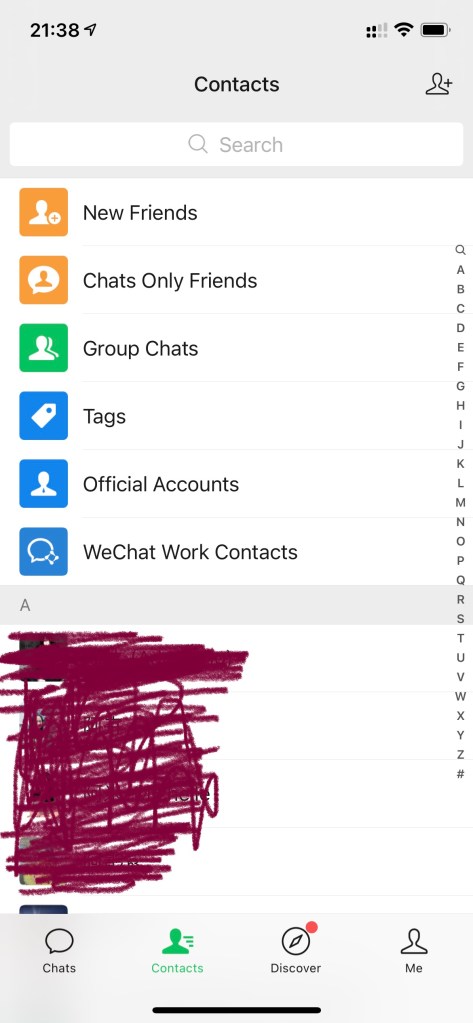
Nowadays, when meeting new people to keep in touch with, we simply pull out our phones and scan our QR code in WeChat. Before adding contacts, we have an option to hide our public posts and befriend someone as a “chat contact” or what I call a “see my life” contact. Discerning who is a chat contact and who is a see my life contact is not always straightforward. Usually, people I meet on trains are immediately classified as a chat contact. Except for that senior headhunter I met one time who was legitimately interested in me and seemed to know all the top people at my company at the time. Can’t hurt to give him a bit more exposure to me, seeing periodic posts and helping keep me top of mind should an opportunity come up. Indeed, I discovered Red Lobster the other day and posted a pic of our visit. He was there earlier in the day and commented that we missed each other.
The Various Categories of Friends in WeChat, today’s Name Card Binder
Then, there was the senior government official who worked at the State Council Information Office. We had a great conversation about politics and perception. Issues between the US and China. Life as a foreigner and misperceptions. He wanted to add me as a friend. So, I added him. The problem is, I can’t remember his name. So, there’s this government official as a WeChat contact who is seeing all my goofy personal and family posts. All of these are train contacts.
And, there’s many like them from a variety of venues. I’ve had great encounters with a range of people over the years, both non-influential and highly influential. For some reason, they must have had a good impression and wanted to add me as a contact. So, I do. And, many I often won’t speak to again, treating all my contacts as natural as can be. Chances are I forgot most of their WeChat account names. I question why I add so many contacts, but it’s become so natural in China to add strangers on WeChat that one doesn’t even question it much anymore.
I was just looking at my “chats only friends” list, and I uncomfortably realized there aren’t many. I just switched a few over as my “see my life” friends because I’ve gotten to know them a bit and feel comfortable with them seeing my personal posts. They are now qualified.
And, scrolling through the “Chats Only” friends, one person jumped out. It’s Miss Tang from Suzhou.
A Chance Encounter in Paradise
There’s a famous saying in Chinese, “Heaven above, Suzhou and Hangzhou below”. (上有天堂,下有苏杭)。Famous foreigners visiting China have been repeating this saying for probably hundreds of years, tickling the Chinese ear with poetic diplomacy. I wax poetic periodically myself. Suzhou and Hangzhou are satellite cities of Shanghai and renown for their leisurely beauty.
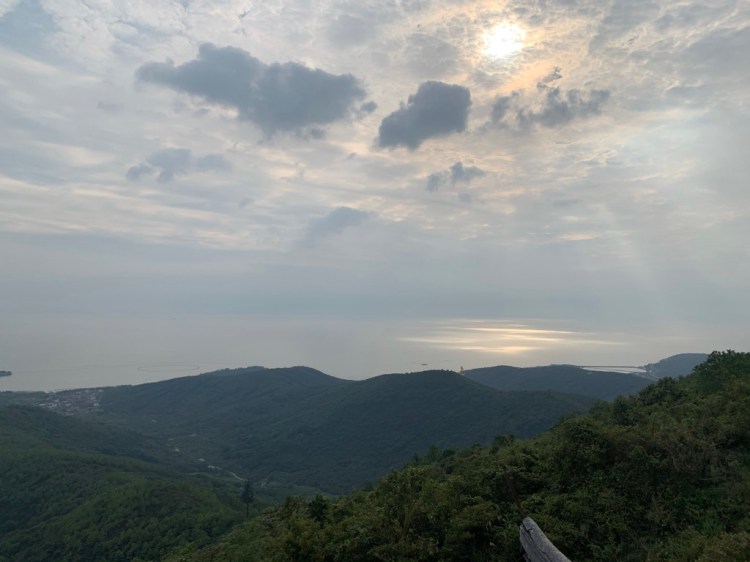
I met Miss Tang in Suzhou last October. I was taking a brief silent retreat trip with a close friend. We chose a location a couple hours away from home. There was a nice mountain with pavilions atop a lush island that became pitch black at 6:30 pm, a rare and ideal state. We found a resort to stay in nestled within a tea plantation. Come to find out, the place we stayed was the origin of Bi Luo Chun (碧螺春), one of my favorite teas. I had no idea until we got there.
Atop the Rolling Hills of Bi Luo Chun (碧螺春) Tea
The master of the resort and hostess was flabbergasted to receive foreigners who could speak Chinese, and showed us around, personally serving tea to us and making sure our stay was special. She was hosting a few people staying there and wanted to know if we would join her tea tour in an hour or so.
Of course, we’d be delighted to.
I met Miss Tang as we walked through the leafy hills of Bi Luo Chun. More accurately, I met her young daughter. Like many children I’ve come across over the years, she found the foreigner interesting. Usually, parents will urge their kids to come over and practice English a bit. But, in this case, we were already in the group and could clearly speak Chinese so the novelty of English practice was superseded by the desire to actually get to know someone different (how child-like and wonderful!).
I was more than delighted to have the opportunity to not be the English learning platform but instead make a good impression as a nice foreigner. While I know the two are not mutually exclusive, I am almost always annoyed at being a tool for English practice, so my heart is usually not in a good place when that happens, politely wishing to duck out as soon as possible. But, when people see me as something more than just English practice, I am always delighted to engage.
So, I spoke and joked with her daughter and the other kids there as we all made our way up the hill. Not too long after, she came up and wanted to add my WeChat.
Strange, I thought. This girl can’t be more than eight years old. My older daughter is six. I don’t let anyone near my daughters. To provide an example, I didn’t allow anyone but me and mom to change diapers. Grandma was also empowered when we were absent. And, the same held true with bathing. Granted, I may be a bit overprotective, but it’s better safe than sorry. There’s no way I’m going to let my kids ask some older guys to add them on WeChat, to say nothing for allowing them to own a phone!
“Perhaps you should ask your mother if it’s ok to add a stranger,” I offer, allowing mom a chance to provide some necessary oversight.
She checks with mom, who I see wave a hand and smile. “No problem.”
Now, it’s down to me. I don’t really want to add this little girl as a friend, of course. But, I also want to be nice. She’s a sweet little girl. I’ll add her as a “chat only” friend, and then delete her later after we leave the resort.
A couple hours later, my friend and I were back at the resort enjoying the fresh tea and breathing in the sights. My WeChat lights up.
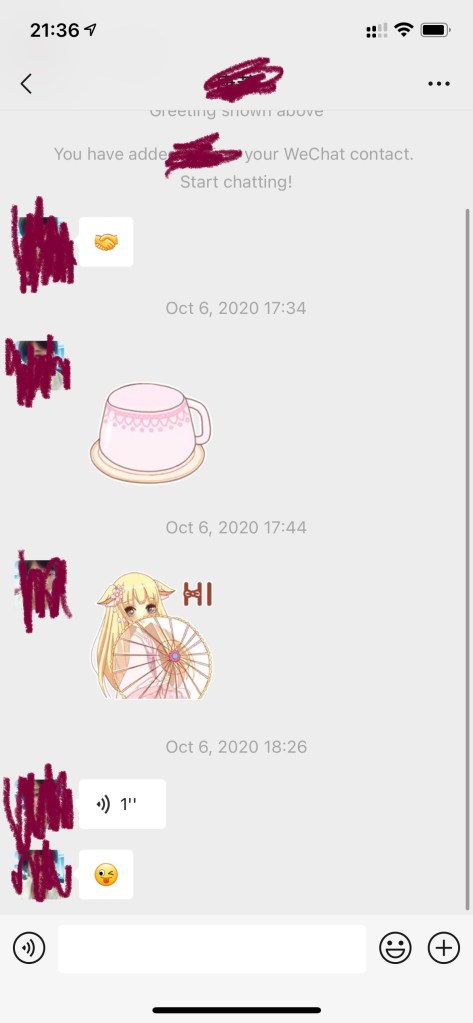
I open up the chat and see a few emoticons from Miss Tang’s WeChat. So, her daughter added to me as her mom’s WeChat friend. Here’s what the window looks like. She spoke a “hello” in there as well (你好)。 I thought it was cute and humorous, how these popped up from a grown woman’s WeChat account (probably without her knowledge) but I didn’t want to encourage it and didn’t respond.
An Unexpected Chat
Cleaning Up the Chat Box
Six months have passed, and I noticed just now that I didn’t delete Miss Tang’s WeChat window or her contact. If I wanted to, I could see all her life moments. I can see where she works, what her family looks like and what she likes to eat, amongst a host of other things. And, all I did was laugh and be friendly while walking up a tea hill for five minutes.
Part of me doesn’t want to delete Miss Tang’s WeChat contact. I don’t know why. Perhaps it’s my time in China that makes me so hesitant to delete a contact. You never know when you will need a relationship. But, what a bizarre way to add a contact. Yet, though it was a child sending emoticons, it does make me feel a bit better knowing that it was an adult’s WeChat account rather than a child’s that added me.
Maybe this is something like the Chinese version of those FaceBook accounts that kids can sign up for under parental supervision. My young niece added me somehow on FaceBook a year or more ago and sends me the most bizarre selfies with no context. This is very similar.
I have deleted many WeChat contacts over the years. Most of these forlorn contacts are women who spend more time posing than pontificating. I just don’t need to see all that stuff when scrolling through the posts.
I remember deleting a contact one time who I would bump into regularly many years ago and confronted me when she saw me.
“I noticed you deleted me. Why did you delete me?” she challenged. Wow. That’s bold.
How could I explain that it was her daily poses in a variety of plumage that I ultimately felt was a bit much for me to be viewing on a regular basis? Some things are better left unsaid. I guess the lack of attention hurts some people.
I left her with shrugged shoulders and a dumb look on my face. Once warm and friendly, she became cold and avoiding. That’s the chance you take when you delete contacts.
Back to the foreigner card.
I miss the days when we would hand out name cards here in China. The simplicity of holding a name card with both hands. The beauty of putting the name card gingerly on the table in front of you for the entirety of the conversation, periodically looking at it. Turning it over and reading the Chinese. Placing it back in its place. And, looking at the person across from you with sincere respect, nodding the head at the right moments. Standing up, and putting the card away gently just as the conversation ended. That grace took me years to get down. I had folders full of name cards, and I loved it.
Though westerners used to think name card etiquette in China was unique and challenging, it’s nothing like the complexity of WeChat etiquette, guessing which type of contact one is and how much content they are allowed to see.
I miss the good ole days.
Oh, I deleted Miss Tang just now. She wasn’t what I would consider a plumage posturing temptation. But, I can’t envision the need to call upon her next time I’m in Suzhou. And, it was a bit of a strange way to add a contact to begin with, having her child add me. Let’s think twice with our children. Because you never know what creeps are out there. And, let’s think twice if we’re happily married about viewing too much unnecessary plumage too. Because, you never know either. And, you don’t really want to know in the end.
One of the things that continues to baffle me is the ratio between the rental cost and the price of purchase for an apartment in downtown Shanghai. It makes no financial sense to buy a place at the current prices nowadays. Consider, the price of the three-bedroom property we live in would sell for the equivalent of 2.5 million USD. The monthly rental, on the other hand, has been a flat 3,400 USD for three years now. It would take 61 years of rental to accrue the equivalent of the purchase price. Why would anyone buy, I ask, particularly considering the rapid aging of the property and inability to control all the external factors. It ties you down.
A Sense of Belonging
“A sense of belonging,” is often the reason I am told. It’s a simple concept, and it’s not rooted in financial metrics. Chinese love to have a sense of belonging. It’s part of what drives the continued purchase behavior for homes that are way out of league for most upper middle-class professionals.
And, perhaps this is what makes me feel a bit differently. I don’t really have a true sense of belonging, in China or in my native United States. I don’t belong anywhere at this stage of life. This is both a source of frustration and freedom.
Frustration when I am constantly reminded of it on a daily basis. Freedom, when I’m able to feel less social pressure like the need to buy an apartment, make my kids take piano class, or needing to eat a staple food (rice) with every meal.
Chinese aren’t the only ones who want a sense of belonging. But, it’s hard to feel like you belong when everyone calls you an outsider. Some say it to my face, some say it behind my back, and many say it right next to me, always clueless that I understand every word.
老外:Old Outsider
The Chinese colloquial for foreigner is “old outsider” and is used to address people who do not look Chinese. It is particularly used to address non-Asian races. The term is so common that people think nothing of using it. But, when children say to their mothers, “look, an old outsider”, moms almost always quiet the child down and urge them not to say that.
I have to say, old outsider is certainly better than being called a foreign devil. A close American friend recently noted that he hasn’t been called that in many years. It was much more common in the past and in southern China. But, there’s a historical reason why foreigners were called devils.
洋鬼子:Foreign Devil
I’m not certain as to why I’m called an old outsider by people who don’t know me, but while it’s a term I despise, it’s one most of us have gotten used to. What are you going to do, confront everyone on a daily basis and allow their preference of appellation to disturb your peace?
Taming the Fire Within
Sometimes I do. But, only when my daughters are involved. Then, the fire stirs up inside me. Don’t you call those girls who were born and raised here and speak just as good Chinese as you an old outsider. You can call me that, but I’m going to put you in your place right…about…now (pride comes before a fall, I should remind myself, instead of puffing out my chest):
“What is an old outsider?” I ask, to the surprised audience.
“Your Chinese is so good,” is the response. That’s always the response. It fires me up almost as much as being called an old outsider.
“What is an outsider?” I continue, unfazed. “Is one who is born here, spends their life and has one parent who is local an outsider?”
Silence. I continue the monologue.
“How about this one. Is one who has Chinese parents, born and raised in the United States, speaks no Chinese and moves here an old outsider?”
Silence. Crickets. Crossing third base, sliding into home.
“Then, I ask you again, what is an old outsider? We all want to belong. We just want to live normally like you and everyone else.” The second part of this line comes from my mother-in-law. She is super smart, good with people and understands my anger and dilemma. She recommends I simply say something like this:
“We are all the same. We just want to belong and live normally like everyone else.”
I often consult mom for cultural wisdom when there’s something that frustrates me. And, I’m getting closer to being able to respond this way. But, I’m not quite there yet.
This almost always ends in humble embarrassment from their side. And, I almost always regret it. I don’t need to challenge people that way, so why do I do it? I can only assume it’s because of 18 years of being called an outsider daily and not telling people it bothers me. And, fatherly protection at wanting to shield my daughters from a feeling of painful exclusion.
I can’t blame people. They think my daughters are beautiful and often comment on them.
“Why does this one have curly hair and the other have straight hair?” is the most common question by strangers. I once used to answer it this way:
“Ask God.”
This response doesn’t make any sense culturally, and it’s extremely rude. From my perspective, it’s related to DNA and having one parent with straight hair and one with wavy frizzy hair. It’s kind of a silly question. But, wouldn’t it be better to say something like:
“Isn’t it amazing, that one daughter would be like mom and one like dad?”
I’ve started saying this, and the response is much better. Isn’t it better to engage people with kindness rather than dig up an old chip on my shoulder?
The funny thing is my older daughter doesn’t seem to be bothered at all by this type of thing. She’s very understanding of people and patient, like mommy. My younger daughter doesn’t like it though. She’s more of a fighter and likes to fight status quo, like daddy.
Developing Thick Skin and Getting on with It
It’s important to understand that most Chinese don’t mean any intentional harm in calling one an outsider. It’s just a product of history, environment and culture. It’s a homogeneous culture and has been one for millennia.
All of the agendas and talk about Diversity & Inclusion that we see in the news media and on LinkedIn and other platforms has its roots in a melting pot culture. Americans are hypersensitive about inclusivity and hypersensitive about racial issues. But, the fact of the matter is that people struggle with prejudice around the world, and it comes in a variety of shapes and degrees. Some of it is intentional. Most of it is unintentional.
Diversity & Inclusion in the China context refers to their 55 ethnic minority groups, who share unique identity, customs, languages, and values. Yet – like the majority Han group – they are all Chinese.
Being called an outsider for years and often not being included as a consideration for certain job positions, and not being invited out to join certain activities has been painful. But, the solution is not to bark out at everyone in anger who makes me feel this way.
In my opinion, the solution is to understand that we – as the human race – are imperfect. And, we are probably all a bit prejudiced on certain things. We tend to like people who act like us, look and think like us.
So, let’s be better to show people that we are worth knowing and befriending. Let’s not just spew anger at whatever agenda suits our fancy but understand we all struggle in this area, and likely have all been hurt in this area at some point of time.
We can choose to harbor bitterness, resentment or try to change the world ineffectually which would result in nothing but disappointment, stress and further anguish. Or, we can develop some thicker skin, engage in respectful – and, sometimes challenging – conversations, and don’t always assume the worst of people.
Frankly, most of the old outsiders here still act like it. They need to step up their game and learn Chinese. If you live in a country, you should learn the language and mix with the people. That’s why I’ve been so aggressive about it with myself. I have high expectations of myself.
Maybe if more of the old outsiders did this, there would be less praise about how awesome one’s Chinese is. It would become a normal part of life and all of us would benefit.
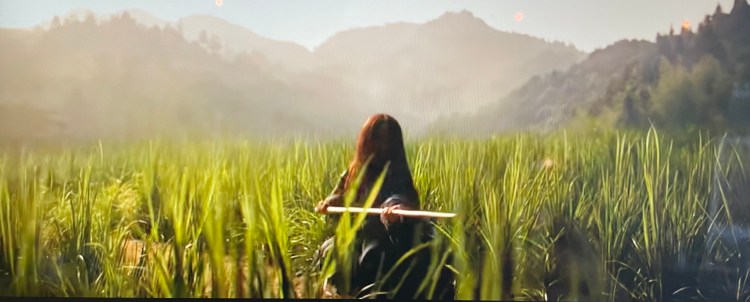
“There have been many tales of the great warrior, Mulan. But, ancestors, this one is mine. Here she is, a young shoot, all green…unaware of the blade.
If you had such a daughter, her chi, the boundless energy of life itself…speaking through her every motion… could you tell her that only a son could wield chi? That a daughter would risk shame, dishonor, exile?
Ancestors, I could not.”
(Source: Opening scene from Disney’s Mulan)
Thus starts the narrative of Mulan, the recent movie released by Disney about a little tomboy girl who became a legend in China. The warrior-aging father who loves and is proud of his wild little daughter but finds himself caught in a conflicting culture.
Last night, my wife had a conference call quite late and I finally decided to watch it. My two daughters both love Disney. One of the malls close to home has a Disney store with a large silver screen at the entrance showing endless loops of the latest films. Mulan was beckoning little girls for months. Sure enough. My little girls couldn’t get enough of the Chinese theme song, called 自己。It’s quite a beautiful song, sung by the main character about the conflict she feels inside becoming a warrior and hiding her true identity to fight on behalf of her family.
My younger daughter, Ariel, in particular is attracted to Mulan. Endlessly asking me to hold her while watching the song, which is peppered with scenes of Mulan fighting and becoming her true self, she simply loves it.
During a recent trip to Shanghai Disney park, we picked up a Mulan dress (one of the “Castle Collection”, a favorite fashion line) and she’s been wearing it every couple days for many months.
So, I don’t know why I was so surprised to be quite moved when I saw the opening scene with those lines last night with little Mulan swinging around in grass and her father watching her quietly.
It suddenly hit me. Wow. That’s us.
Strong-Willed Children – one of the Hard Days
Parenting Isn’t for Wimps. I know I’ve seen this somewhere. LinkedIn? Facebook? United Nations official website? I can’t be too certain. But, regardless of the source, one thing that is certain is the veracity of that statement.
Let me tweak that one a bit: Hands-on parenting isn’t for wimps. I’m only six years in with two young girls.
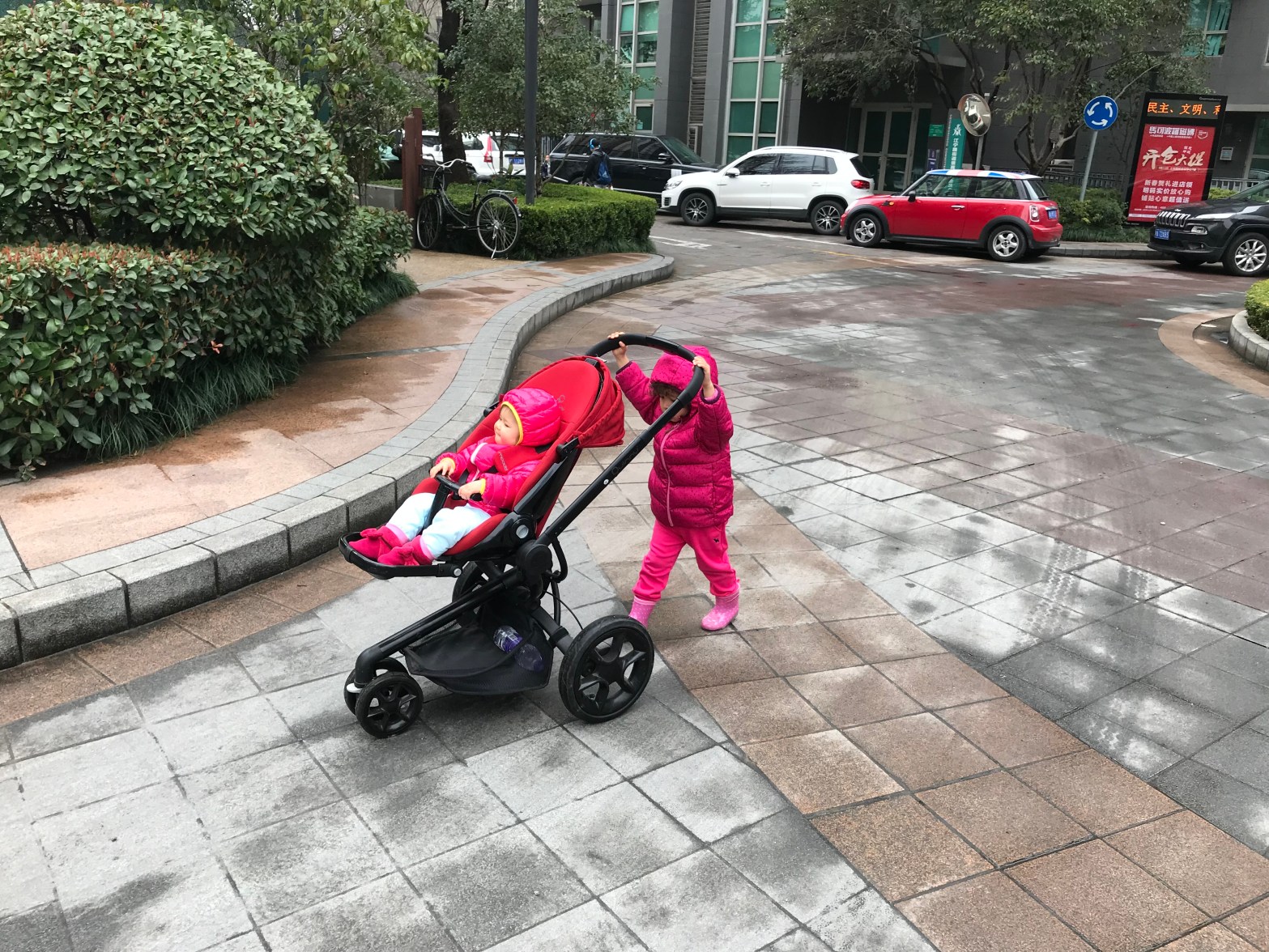
A recent family photo
I actually don’t know of any other kind of parenting. Thousands of diapers, thousands of sleepless nights(I’m sure it must have exceeded hundreds), and yet probably millions of laughs (yeah, I think it may have reached millions by now).
If I had a nickel for every time my wife and I look at their pictures and laugh after they’ve gone to sleep, I may be well on my way to buying that lakeside property back in my home town area I’ve dreamed about.
I’m convinced there is nothing in the world like hands-on parenting. It is the only venue I’m aware of where you are equally exhausted and equally joyful – simultaneously!
***
I wrote the above few paragraphs earlier in the morning, four hours previously. Since this time, my younger daughter had erupted into one of the worst tantrums I can remember, for about 45 minutes or so.
It’s happening less and less, but it still happens. I will sometimes deal with it decisively, but on this day I dilly-dallied. Why? My older daughter came into our room at 3am crying. I don’t know why. I took her back and put her down, laying down on an adjacent bed to her sister (they have a bunk bed and there’s another single bed next to it).
She seemed ok initially then wouldn’t sleep. So, I lifted her down and lay her next to me. She seemed at peace and it worked a bit. Then, I helped her back up to the top bunk. Then, she began to complain about the brightness of the night light, so I turned it off. Just at this moment, I began to fall asleep when the window shades were pulled open and I was blinded by the 6am sun smiling down on my sorry self.
At this point, I direct her back to mom’s. I know mom will be getting up for the day for a long day at the office, so I see my job to take care of the kids when they get up at night so she can get a good nights rest before one of her really long days.
And, don’t get me wrong. When she doesn’t have a crazy long day or isn’t at the office, she’s just as hands-on as I am.
Since Covid, I’ve been working more flexible hours at home so I’ve been retuning myself to focus more on taking care of the kids at this time. I spent all of 2019 living in another city, so it’s been great to spend more time with the kids, and I see it as a great chance to love – and to discipline – in the way a loving dad does best.
And, I’ve learned a lot in the process.
With days like today – a seemingly endless night followed by a historic meltdown – I remind myself of all the progress the kids have made.
Real Progress
And, it’s been huge. My older daughter doesn’t do tantrums. She’s extremely considerate of peoples’ feelings and highly empathetic and intuitive for a six year old.
My younger girl just turned four and is doing much better. We missed at least a year or more of discipline because we didn’t have a normal year when she turned one. Shortly after her first birthday, we were rocked with a major medical crisis and we split our time between the US and China to address it.
Suffice it to say, we are happy she’s alive and well today. For the past year or more, we can focus on the loving discipline, and I feel we’ve had a bit of catch up to do. But, it too is progressing well.
And, what better way to focus my mission and vision than to raise my daughters well? What better legacy to leave in this life?
Yet, how hard it is at times.
I was powerless this morning. I tried everything. And, I’m proud of myself that I didn’t explode. I called out to the Lord for help. For patience. I even stepped away briefly. Finally, she said “Daddy, I miss you.” And, that was it. The tantrum broke, and the relationship mattered more than getting her way to her. I opened the door, picked her up and had tears in my own eyes. I can’t remember having that happen after a tantrum, but I can’t remember feeling so exhausted and powerless for a long time either. And, that was the right thing to do. I handled it well. So, it’s not just the kids that are growing. I’ve learned how to keep my cool too.
That’s why hands-on parenting isn’t for wimps. And, though it’s been one of the most difficult things I’ve tackled in life, I wouldn’t change anything.
After those episodes this morning, the day went wonderfully. We went hand-in-hand, literally skipping our way to kindergarten.
And, it’s hard not to feel like the hardest part of the day is done. I’ve got a meeting in the afternoon and a few things to take care of. But, clients and prospects are easy.
I think other hands-on parents who have dealt with challenges will identify strongly with what I say when I say I love being a dad.
Yesterday, my wife and I went to pick the kids up together and when the teacher was watching Ariel and I interacting, she said to my wife “she really loves her daddy.”
And, she does. When I pick them up, the kids all come out single file. But, not her. She yells “Daddy!!” And runs out to me, all heart and bursting with life. My other daughter, Vera, sweetly holds my hand and smiles.
This might sound judgmental, but a lot of people picking up the kids at school aren’t the parents. They are caretakers or grandparents. I think if possible, it’s a better model to do it yourself. It’s a lot harder. But, the pay off is huge.
Here’s a few things I’ve learned by being a hands-on daddy:
It shapes us to be better men. Experiencing the joy, difficulty, and powerlessness at times builds character. When you realize there is so much you can’t control, you learn how to let go of some things and try to influence others. If you believe in God, you learn how to rely on the Lord for both patience and wisdom and you begin to see God’s love in a new light. Hands-on daddy’s don’t have a whole lot of “my time”. Or, at least, it is parceled out much more than otherwise.
It creates deeper joy in the heart. Being a “thinker” type, I have struggled with melancholy for years. I would often meditate on the bigger questions of life’s meaning, internalize pain and ruminate endlessly in an unhealthy manner. Having children has changed all that. For one thing, I’m too busy just doing life. For another, I’m thinking about someone else’s needs over my own. The selfless act of parenting and the joy experienced when seeing real growth in your children is significant.
It’s best done in partnership. Mom and dad both need to be involved. Regardless of what some agendas or beliefs may claim, men and women are different and come with different assets and challenges. There is a real need to share the duties. Share the housework. Then, you need less outside help. And, for me, that’s simply awesome. I don’t like outsourcing family care. And, there’s a lot of outsourcing in China.
Maintain a hobby / do something separate and meaningful. There’s a very real need to rest and recharge. For me, that’s reading and writing. Nothing satisfies like a good book or a journal accompanied with a strong coffee. Nurture something independent. I’ve also been involved in ministry, contributing to others men’s development. That has been satisfying and fulfilling as well.
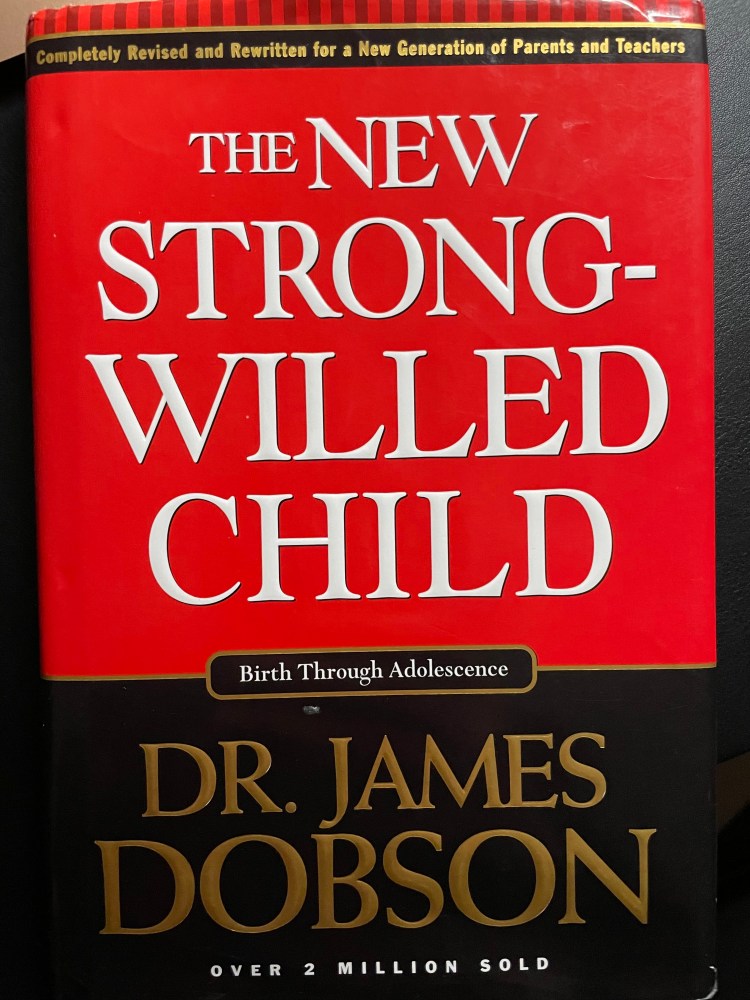
Get help when you need to. Call your mom or dad and get advice. There’s wisdom there! I also found a couple books to be helpful, one in particular by James Dobson entitled “The Strong-Willed Child” (below). Pick that up if you believe you may have a little leader in the making. It teaches you how to love and shape a child’s character without breaking their will.
Great book on how to raise future leaders
Finally, good luck! If you haven’t been that hands-on, give it a try. I’m always available for a chat.
“Bradley, you’ve gained weight again,” she pipes with high-pitched confidence and purely good intentions (at least I think). The elevator opens and she moves toward the break room, seizing a small square cloth to begin wiping the table.
Dejected once again, I walk past desks and desks of young and slim Chinese men and women in the Beijing office who take no notice of fattie Braddie as I saunter toward my own desk in the far end of the room. Safely inside my corner cubicle, I can boot up my computer and meekly message people from behind a mouse. There’s a long day ahead of me.
ACT II: THE FOLLOWING DAY. SCENE: THE SAME EMPLOYEE ELEVATOR. SAME LADY.
“Bradley, you’re gaining weight again,” she pipes up again over the sound of others speaking and through spectacles with hair cut short and curly so common for late-fifties women regardless of country of origin.
What the heck am I letting this lady bully me for? This is ridiculous. She doesn’t have any sense of style herself and she could be my mother, for crying out loud.
Before she walks over to pick up a cloth and start dusting, I decide it’s time to stick up for myself. “Look, you’ve been saying I’ve been gaining weight for weeks now. That’s ridiculous and impossible. There’s no way I can gain weight daily,” I plead.
Finally, I’m vulnerable and it shows.
“Bradley, it’s very good to gain weight. Very healthy.”
I can’t win. After complaining to a colleague about the company cleaning lady who seems to have no sense of propriety or boundaries, I get a different perspective.
“Chinese say this to draw each other closer. It’s not meant to be offensive. She really likes you, and is watching out for you,” my colleague shares.
Kind of like a mom. I guess it would be the cultural equivalent of the exact opposite statement you may hear from some parts of the US.
“Son, you need to get some meat on those bones.”
For some people, that would sound offensive. For me, it simply sounds like some good-natured commentary, and I wouldn’t think anything of it. And, come to think of it, that cleaning lady really did like me and treated me very well. I think she relished the novelty of speaking with a foreigner directly and had that great nature of how Beijingers watch out for their foreign friends.
Well, I’ve been eavesdropping on people telling others they are getting fat or getting too thin for years now, and the jury is still out in my head. I can’t tell if people are fine with it or not. Certainly, Chinese don’t take nearly as much offense at it as I did.
Pan over to the United States.
If I spend too much time on the Yahoo home page, I’ll learn new vocabulary like “body shaming” and I’m sure many other terms that are very foreign here.
The cover story of the weekend magazine for The Wall Street Journal this past couple weeks is Ashley Graham, the renown plus-sized model who made her name from breaking out in Sports Illustrated. Entitled “Her Game, Her Rules”, a cursory flip through the glossy will reveal larger confidence in a variety of poses.
It’s probably a good thing to celebrate a range of weight options as definitions of beauty, as long as people actually feel that way. And, I guess that’s the key question. Do people actually see larger size as more beautiful or is it a way to legitimize a cultural issue of over nutrition?
There’s no question that I gained weight when I was in the US in 2018 and the primary reason was that I was like a child in a candy store. Quite literally.
Milk Duds would halt me in my tracks during a Target run. Oh, man. Milk Duds! I haven’t seen those for years. That creamy caramel (pronounced care-a-mell like in the commercials) surrounded by smooth chocolate. I’m getting the large sized carton. And, why not? I deserve it.
And, I’d hop into the car and drive home.
Milk Duds. Buffalo Wings with bleu (spelled like that) cheese. Ghirardelli chocolate squares with salted care-a-mell filling. You name it, I owned it. Ate it. Then, wore it.
Now, I’m not saying all Americans do that. I’m saying that was my experience. And, combined with a general lack of mobility for months it was impossible for me to not gain weight.
But, in no way am I going to celebrate that as my new standard of what is handsome. I used to make a joke with people that during international flights, my confidence would begin to rise the closer I would get to the US timezone and subsequently sink the closer I would get to the China timezone – where I’m fat to everyone who cares to say so.
In the US, I look great. So does everyone else.
Just open up FaceBook. “Looking great!” “Beautiful!” “You’re wonderful”. It seems like a culture of affirmation and encouragement. But, I question some of the authenticity.
Then, you get to China which seems like a culture of criticism and discouragement. But, that too is not fully the case. Neither culture can be oversimplified.
Yet, I look around. And, these people are in pretty good shape. I have always wondered is part of the reason because they are always hearing people tell them they are gaining weight. Almost like a social system of keeping themselves in check.
I don’t know though. The most popular celebrity today in China is an actress names Yang Mi (below). She’s everywhere. I personally don’t see the massive appeal. But, I attribute this to my age. In China, it seems like the standard of beauty over the past decade has become the opposite of the US – it has moved toward thinner people.
I can’t stand people telling me I’m gaining weight. But, I don’t want people telling me I look great if I clearly have work to do. It’s not good for my health to gain weight.
Frankly, my take is that I don’t think either cultural approach is ideal. We shouldn’t be commenting on people’s figures. It’s simply not helpful. We also shouldn’t be praising people inauthentically.
The jury is out with me so far on this one. But, it came to mind today while I saw US advertising in a mall that there seems to be a huge cultural gap that I thought would be interesting to highlight.
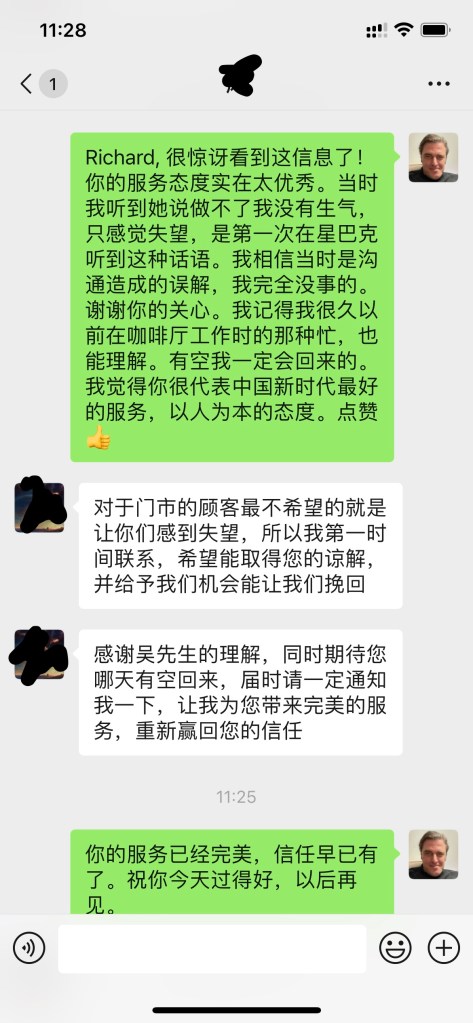
Let me tell you about Richard. I don’t know his given Chinese name but it doesn’t really matter. Last year when adding me on WeChat, he told me his name was Richard and he calls me Mr. Wu anyway. That’s my Chinese name, using my wife’s family name for convenience (Wu Lei, surname first).
Richard just blew me away this morning (and, that’s not easy. I’m a pretty big guy). It was such a surprising experience that I felt compelled to write about it and share it. So, here’s the story.
Richard 今天早上让我大吃惊。这是一次如此令人惊讶的经历,我不得不写下来和大家分享。所以,故事是这样的。
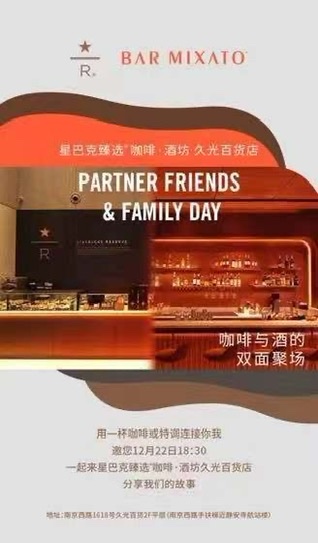
I just finished dropping off the kids at kindergarten and I was on the phone with my dad. I often like to do our catch ups at this time. Like usual, I like to accompany the chat with a nice pour-over coffee. There’s this great Starbucks Reserve in the neighborhood that isn’t too crowded. There’s a faux waterfall and pond just outside, creating a perfect white noise that drowns out all the honks and clanks of the city.
Speaking through my blue tooth airpods, I step forward and pause the conversation to order my pour-over, a Hawaii Kau. I’m a bit of a coffee snob, admittedly. I just like nice coffee.
“What? This is the first time I’ve heard someone at Starbucks say they can’t do it.”
“什么?这是我第一次听到星巴克有人说他们做不了。”
“See all these orders. There’s about a twenty minute wait.”
“看看这些杯子。大约要等20分钟。”
I look at the cups lined up and see how unseasonably busy they are. Small pause. And, I walked away.
我看着一排排的杯子,发现它们有多么反常地忙碌。稍作停顿。然后,我走开了。
That’s all. Nothing dramatic. No explosive anger. No resentment or rude commentary. I simply thought more efficient to make my own later and should get back to my phone call.
“Hello Mr. Wu. Firstly, please allow me to sincerely apologize on behalf of my partner. I just called the store to understand the situation. This morning, the partner (staff member) who served you is a new partner in the store. Seeing there were many drinks in the cue, she was concerned you would wait too long and conveyed the wrong message to you. I would like to apologize for this.
At the same time, any time you are available and have time, please return to our store and allow us to serve you again, providing a renewed experience and making up for the unpleasant feelings this morning. I would like to bring you this special Costa Rica bean, which is just about to be launched in the market.”
Whoa. I’ve been in China for almost two decades, and I’ve had some big surprises over the years. And, I’ve had some great customer service over the years. (I’ve also had some extremely bad customer service, by the way). But, this is the first time I can remember actually being blown away with superb service.
What Richard did was “over the top.” It far exceeds what is called for in the situation. And, yet, it feels wonderful.
无可否认,Richard远远超出了当时的要求。然而,我感觉很棒。
When seeing this message, I had to think to myself of whether or not I was inappropriately emotional. And, the answer is no. I was simply disappointed and verbalized it in a normal tone of voice. And, I walked away normally, not storming off.
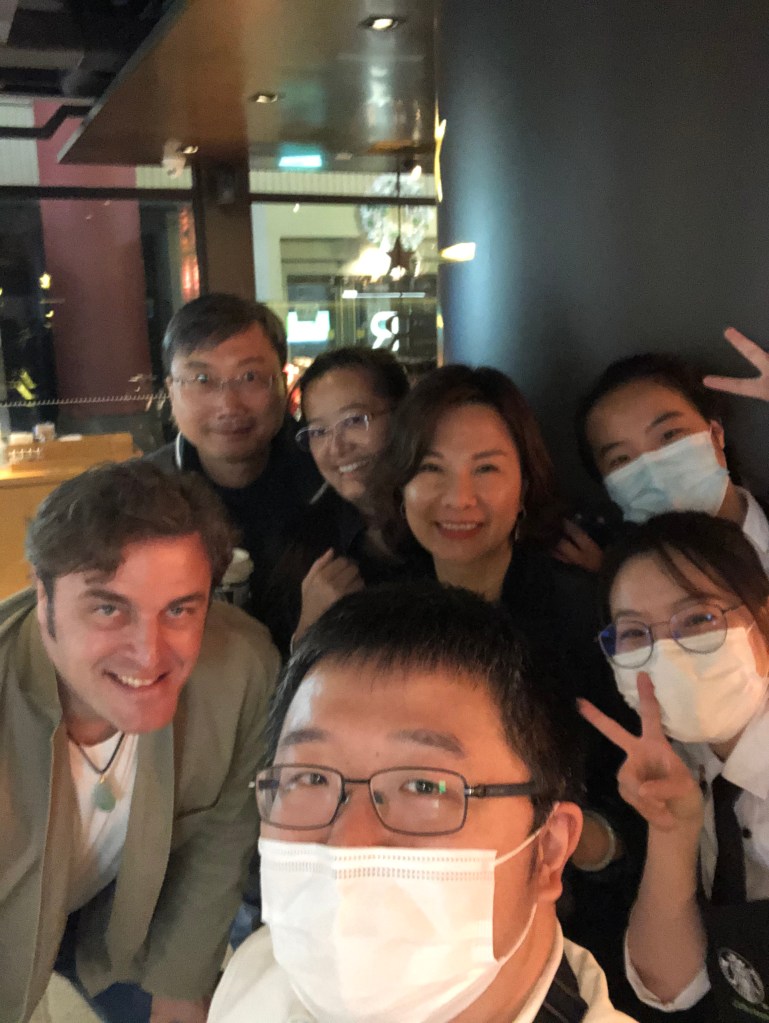
So, I wanted Richard to know how much I appreciated him. His approach is unique and I wanted to encourage him – and, also let him know there isn’t an unhappy customer out there waiting for the next mistake.
“Richard, I am very surprised to see your message! Your customer service is superb. At the time, when I heard her say the coffee couldn’t be made, I wasn’t angry. I was simply disappointed. It was the first time I heard this said at Starbucks. I trust it was simply the way of communicating that caused a misunderstanding. I’m completely fine, thanks for the concern. I remember a long time ago when I worked at a coffee shop when it was busy like that, so I completely understand. When I have time, I will certainly return. I think you are representative of China’s new generation of excellent customer service. People first. Thumbs up.”
He further expressed that the thing he is most concerned about it disappointing customers at the store, so he wanted to reach out right away, seek retribution and regain trust. He reminds to give him a heads up next time I plan to stop in so I can get some great service again.
Wow again. I let him know that he won my trust along time ago, not to worry.
我让他知道他很久以前就赢得了我的信任,不用担心。
It’s true. Last year, there was a visiting group of market research people in the store. I was there, having my regular pour-over and focused on my own thing in the corner. I saw these people regarding me from afar with interest. Some time later, they came over and introduced themselves. They were speaking with some customers to understand their experience and were told I would be someone good to talk to.
Some time before this, I would sit near the pour-over station and chat with Richard and other partners of his about my experience in China. I would sometimes brag about how I was here at the first Starbucks when it opened in 1999, talking about how things were then.
These young coffee whizzes listen with honest respect and interest and ask me questions, probably trying to think back to how it was in kindergarten when their parents dropped them off and took a walk to get…certainly not coffee back then.
So Richard and probably a few others were familiar with me, saw me bring my kids in from time to time and how the place seemed like a quiet refuge for me.
所以Richard和其他一些人可能对我很熟悉,看到我时不时地带着孩子们来,等等。
Naturally, I’d be an interesting candidate for internal market research.
当然,我会是一个有趣的候选人进行内部市场研究。
Picture with internal customer research team. Richard, masked in the front, taking the picture
I think this group got more than they bargained for. Having spent my professional career building brands and managing reputations, I shared my perspective on many things, affirming the majority of how Richard and this specific store were doing.
This was the start of a new relationship with Richard. He added my WeChat and although we don’t chat on a regular basis, he clearly has me in mind.
这是和Richard新关系的开始。他加了我的微信,虽然我们不经常聊天,但他显然在关注我。
Back in the end of December, Starbucks was opening a new store, a coffee shop / bar fusion in a mall area nearby. He sent me the below invite. A special pre-opening event invitation for friends and family of Starbucks. How nice. A VIP experience with free drinks, networking and learning a day or two before the public.
Closer to the date, Richard sent me a WeChat to check in and see if I was going. He wanted to be sure my name was on the list.
离约会更近的时候,Richard给我发了一个微信,看看我是否要去。他想确定我的名字在名单上。
Unfortunately, I wasn’t able to attend the VIP event, but his invitation made me curious and being in the neighborhood I actually stopped in during the day. Sure enough, lots of people milling about, an almost “waiting for the celebrity” feeling. The lady guarding the door politely declined my entry and mentioned they weren’t open for a couple more days. Too bad I couldn’t join the fun this time.
That was my last WeChat interaction with Richard before today.
这是我在今天之前最后一次与Richard的微信交流。
To wrap this up, I’d like to offer a couple summary points.
最后,我想总结几点。
People are important. Companies talk about putting people first and customers first. But, there are no CRM tools that can teach you how to put people first. It’s a mindset. You’ve got to have the right people working for you who understand the value of other people. Notice how Richard doesn’t berate his new team member. He calls her a “partner” and mentions a misunderstanding, and takes responsibility. He has what many would call high EQ.
Relationships are interpersonal. This may sound tautological. But, what I mean is that good customer relationships are about give and take. Richard is boldly giving in his customer service. I too was pretty bold and giving in my market research feedback and appreciation last year. It’s symbiotic, not synthetic.
Brands need to act fast. While I am not the kind of person who would go and blow up a small incident like this morning, some people would. I am experienced in crisis management, and have helped organizations walk through some notorious crises. One of the first principles is to know your audience and respond fast and first. I’m not sure if Richard was guided by this principle, if it was taught, but his behavior felt sincere and natural. I’ve seen far too many situations today where brands observe unhappy customers, discuss how to respond and don’t take any restorative action until the complaint foments into a media issue days later. Simply reaching out to people with sincerity works!
Kill the cultural superiority. Each culture struggles with feeling superior to the other at times. I remember ordering a vodka martini in Beijing over twenty years ago. I tasted gin, and tried to return it. It didn’t matter that I didn’t order it. I already drank it. I couldn’t argue my way to getting back my 60 RMB, which was extremely expensive back in those student days. Well, those days are over. There is something to be learned from the Chinese in how they do customer service today.