

I remember many years ago negotiating a raise with a boss, trying to make a case for my increased value. I don’t remember what proof points I used to back up my case, but I remember this statement:
“No, you can’t really play the foreigner card on this.”
I don’t know why I remember this without remembering any other details of the conversation. I can only assume that it may be because my eyes were opened to a dynamic that I never thought about before: there is a foreigner card. And, then immediately: why have I never played it?
A Truly Foreign Card
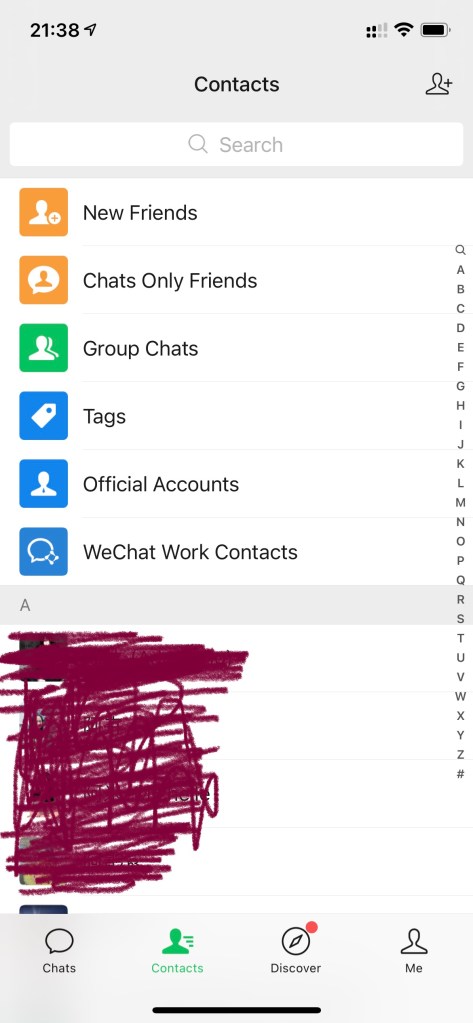
Nowadays, when meeting new people to keep in touch with, we simply pull out our phones and scan our QR code in WeChat. Before adding contacts, we have an option to hide our public posts and befriend someone as a “chat contact” or what I call a “see my life” contact. Discerning who is a chat contact and who is a see my life contact is not always straightforward. Usually, people I meet on trains are immediately classified as a chat contact. Except for that senior headhunter I met one time who was legitimately interested in me and seemed to know all the top people at my company at the time. Can’t hurt to give him a bit more exposure to me, seeing periodic posts and helping keep me top of mind should an opportunity come up. Indeed, I discovered Red Lobster the other day and posted a pic of our visit. He was there earlier in the day and commented that we missed each other.
Then, there was the senior government official who worked at the State Council Information Office. We had a great conversation about politics and perception. Issues between the US and China. Life as a foreigner and misperceptions. He wanted to add me as a friend. So, I added him. The problem is, I can’t remember his name. So, there’s this government official as a WeChat contact who is seeing all my goofy personal and family posts. All of these are train contacts.
And, there’s many like them from a variety of venues. I’ve had great encounters with a range of people over the years, both non-influential and highly influential. For some reason, they must have had a good impression and wanted to add me as a contact. So, I do. And, many I often won’t speak to again, treating all my contacts as natural as can be. Chances are I forgot most of their WeChat account names. I question why I add so many contacts, but it’s become so natural in China to add strangers on WeChat that one doesn’t even question it much anymore.
I was just looking at my “chats only friends” list, and I uncomfortably realized there aren’t many. I just switched a few over as my “see my life” friends because I’ve gotten to know them a bit and feel comfortable with them seeing my personal posts. They are now qualified.
And, scrolling through the “Chats Only” friends, one person jumped out. It’s Miss Tang from Suzhou.
A Chance Encounter in Paradise
There’s a famous saying in Chinese, “Heaven above, Suzhou and Hangzhou below”. (上有天堂,下有苏杭)。Famous foreigners visiting China have been repeating this saying for probably hundreds of years, tickling the Chinese ear with poetic diplomacy. I wax poetic periodically myself. Suzhou and Hangzhou are satellite cities of Shanghai and renown for their leisurely beauty.
I met Miss Tang in Suzhou last October. I was taking a brief silent retreat trip with a close friend. We chose a location a couple hours away from home. There was a nice mountain with pavilions atop a lush island that became pitch black at 6:30 pm, a rare and ideal state. We found a resort to stay in nestled within a tea plantation. Come to find out, the place we stayed was the origin of Bi Luo Chun (碧螺春), one of my favorite teas. I had no idea until we got there.

The master of the resort and hostess was flabbergasted to receive foreigners who could speak Chinese, and showed us around, personally serving tea to us and making sure our stay was special. She was hosting a few people staying there and wanted to know if we would join her tea tour in an hour or so.
Of course, we’d be delighted to.
I met Miss Tang as we walked through the leafy hills of Bi Luo Chun. More accurately, I met her young daughter. Like many children I’ve come across over the years, she found the foreigner interesting. Usually, parents will urge their kids to come over and practice English a bit. But, in this case, we were already in the group and could clearly speak Chinese so the novelty of English practice was superseded by the desire to actually get to know someone different (how child-like and wonderful!).
I was more than delighted to have the opportunity to not be the English learning platform but instead make a good impression as a nice foreigner. While I know the two are not mutually exclusive, I am almost always annoyed at being a tool for English practice, so my heart is usually not in a good place when that happens, politely wishing to duck out as soon as possible. But, when people see me as something more than just English practice, I am always delighted to engage.
So, I spoke and joked with her daughter and the other kids there as we all made our way up the hill. Not too long after, she came up and wanted to add my WeChat.
Strange, I thought. This girl can’t be more than eight years old. My older daughter is six. I don’t let anyone near my daughters. To provide an example, I didn’t allow anyone but me and mom to change diapers. Grandma was also empowered when we were absent. And, the same held true with bathing. Granted, I may be a bit overprotective, but it’s better safe than sorry. There’s no way I’m going to let my kids ask some older guys to add them on WeChat, to say nothing for allowing them to own a phone!
“Perhaps you should ask your mother if it’s ok to add a stranger,” I offer, allowing mom a chance to provide some necessary oversight.
She checks with mom, who I see wave a hand and smile. “No problem.”
Now, it’s down to me. I don’t really want to add this little girl as a friend, of course. But, I also want to be nice. She’s a sweet little girl. I’ll add her as a “chat only” friend, and then delete her later after we leave the resort.
A couple hours later, my friend and I were back at the resort enjoying the fresh tea and breathing in the sights. My WeChat lights up.
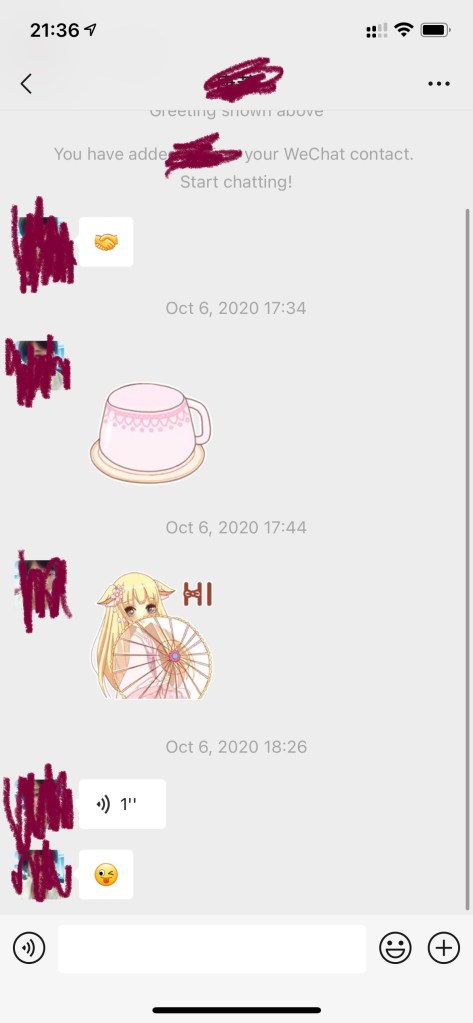
I open up the chat and see a few emoticons from Miss Tang’s WeChat. So, her daughter added to me as her mom’s WeChat friend. Here’s what the window looks like. She spoke a “hello” in there as well (你好)。 I thought it was cute and humorous, how these popped up from a grown woman’s WeChat account (probably without her knowledge) but I didn’t want to encourage it and didn’t respond.
Cleaning Up the Chat Box
Six months have passed, and I noticed just now that I didn’t delete Miss Tang’s WeChat window or her contact. If I wanted to, I could see all her life moments. I can see where she works, what her family looks like and what she likes to eat, amongst a host of other things. And, all I did was laugh and be friendly while walking up a tea hill for five minutes.
Part of me doesn’t want to delete Miss Tang’s WeChat contact. I don’t know why. Perhaps it’s my time in China that makes me so hesitant to delete a contact. You never know when you will need a relationship. But, what a bizarre way to add a contact. Yet, though it was a child sending emoticons, it does make me feel a bit better knowing that it was an adult’s WeChat account rather than a child’s that added me.
Maybe this is something like the Chinese version of those FaceBook accounts that kids can sign up for under parental supervision. My young niece added me somehow on FaceBook a year or more ago and sends me the most bizarre selfies with no context. This is very similar.
I have deleted many WeChat contacts over the years. Most of these forlorn contacts are women who spend more time posing than pontificating. I just don’t need to see all that stuff when scrolling through the posts.
I remember deleting a contact one time who I would bump into regularly many years ago and confronted me when she saw me.
“I noticed you deleted me. Why did you delete me?” she challenged. Wow. That’s bold.
How could I explain that it was her daily poses in a variety of plumage that I ultimately felt was a bit much for me to be viewing on a regular basis? Some things are better left unsaid. I guess the lack of attention hurts some people.
I left her with shrugged shoulders and a dumb look on my face. Once warm and friendly, she became cold and avoiding. That’s the chance you take when you delete contacts.
Back to the foreigner card.
I miss the days when we would hand out name cards here in China. The simplicity of holding a name card with both hands. The beauty of putting the name card gingerly on the table in front of you for the entirety of the conversation, periodically looking at it. Turning it over and reading the Chinese. Placing it back in its place. And, looking at the person across from you with sincere respect, nodding the head at the right moments. Standing up, and putting the card away gently just as the conversation ended. That grace took me years to get down. I had folders full of name cards, and I loved it.
Though westerners used to think name card etiquette in China was unique and challenging, it’s nothing like the complexity of WeChat etiquette, guessing which type of contact one is and how much content they are allowed to see.
I miss the good ole days.
Oh, I deleted Miss Tang just now. She wasn’t what I would consider a plumage posturing temptation. But, I can’t envision the need to call upon her next time I’m in Suzhou. And, it was a bit of a strange way to add a contact to begin with, having her child add me. Let’s think twice with our children. Because you never know what creeps are out there. And, let’s think twice if we’re happily married about viewing too much unnecessary plumage too. Because, you never know either. And, you don’t really want to know in the end.
Better safe than sorry.
 Stark Discussion